Profitable Blogging Niche: A one-stop solution for niche finder
Starting a blog is easier than ever but building a blog that consistently attracts readers and generates income requires careful planning. Many beginners invest time in publishing articles, designing websites, and learning search engine optimization, only to discover that their chosen topic attracts very little traffic or offers few realistic monetization opportunities.
The problem is not always poor writing or ineffective SEO. Sometimes, the underlying problem is the niche itself.
A profitable blogging niche is a specific subject area that attracts an identifiable audience, addresses problems people genuinely want to solve, and offers sustainable opportunities to earn money through advertising, affiliate marketing, sponsored content, digital products, services, or other business models.
However, profitability does not depend on a topic alone. A blog about personal finance, technology, health, travel, or food can generate income, but none guarantees success. Results depend on audience demand, competition, content quality, credibility, marketing, and the ability to connect readers with useful solutions.
For example, a general technology blog may compete with thousands of established publishers. A focused website that helps small businesses choose affordable business software could serve a more clearly defined audience and create opportunities for software affiliate commissions, comparison guides, and consulting services.
That difference is important.
Instead of asking, “Which blogging niche makes the most money?”, a better question is, “Which audience can I help consistently, and how can I build a sustainable business around those needs?”
This guide explains how to identify a profitable blogging niche, evaluate its potential, research competition, select keywords, develop a content strategy, and build multiple income streams. Whether you are starting your first blog or considering a new direction for an existing website, the goal is to help you make a decision based on evidence rather than hype.
What Is a Profitable Blogging Niche?
A blogging niche is the particular subject or audience a website focuses on. It defines the problems the blog addresses, the readers it serves, and the information or solutions it provides.
A profitable niche combines three essential elements:
- Audience demand: People actively search for information, advice, products, or solutions related to the topic.
- Monetization potential: Businesses or readers are willing to pay for relevant products, services, tools, or premium information.
- Competitive opportunity: The publisher can create useful, differentiated content and reach the intended audience.
Consider the broad subject of fitness. A fitness blog could cover everything from bodybuilding and yoga to sports nutrition and home workouts. A more focused niche might help busy professionals develop short home-workout routines using minimal equipment.
The narrower website has a clearer audience and can develop highly relevant articles, equipment recommendations, workout plans, and downloadable resources.
This does not mean every blog should target a tiny subject. A niche must be sufficiently focused to establish relevance while offering enough room for growth.
A profitable blogging niche also does not need to generate income immediately. Search traffic may take time to develop, affiliate programs may have approval requirements, and digital products may require an established audience. Profitability should be assessed over a realistic period, including expenses and the work required to maintain the website.
Why Choosing the Right Blogging Niche Matters
Your niche influences nearly every major blogging decision, from article selection and website branding to monetization and long-term growth.
1. It determines your target audience
A website with a clear niche understands whom it serves. That makes it easier to identify readers’ questions, concerns, budgets, and purchasing decisions.
For example, a blog about WordPress performance can target website owners who want faster loading times, better user experiences, and improved technical performance.
Its audience may be interested in caching plugins, managed hosting, image optimization tools, performance testing, and technical tutorials.
A general website covering unrelated subjects may find it harder to create a consistent experience for returning readers.
2. It influences your earning opportunities
Different niches support different business models.
A blog about software can earn through affiliate programs, sponsored tutorials, and product comparisons. A food blog may generate income through advertising, brand partnerships, cookbooks, and meal plans.
A personal finance blog might attract valuable commercial opportunities, but it also requires particular care with accuracy, qualifications, and potentially consequential financial advice.
The important point is that monetization opportunities should exist naturally within the audience’s needs. A topic with many potential affiliate products is not automatically profitable if readers have little trust in the publisher.
3. It shapes your SEO strategy
A well-defined niche makes it easier to organize content into topic clusters, build internal links, and demonstrate subject knowledge.
For instance, a blog about SEO could publish a central guide to keyword research and support it with detailed articles about search intent, keyword difficulty, long-tail keywords, on-page SEO, and internal linking.
This creates a connected library of information rather than a collection of unrelated posts.
For additional guidance, explore BlogEarns’ SEO resources, including its available keyword research and optimization content.
4. It determines whether you can sustain publishing
Blogging is a long-term commitment. If you choose a subject solely because someone claims it is highly profitable, you may struggle to produce useful content after the first few weeks.
A niche that matches your knowledge, professional experience, interests, or willingness to research makes consistent publishing more realistic.
You do not need to be the world’s leading expert before starting. However, you should be prepared to learn the subject carefully, verify important claims, and improve your content as your knowledge develops.
The Most Important Factors That Make a Niche Profitable
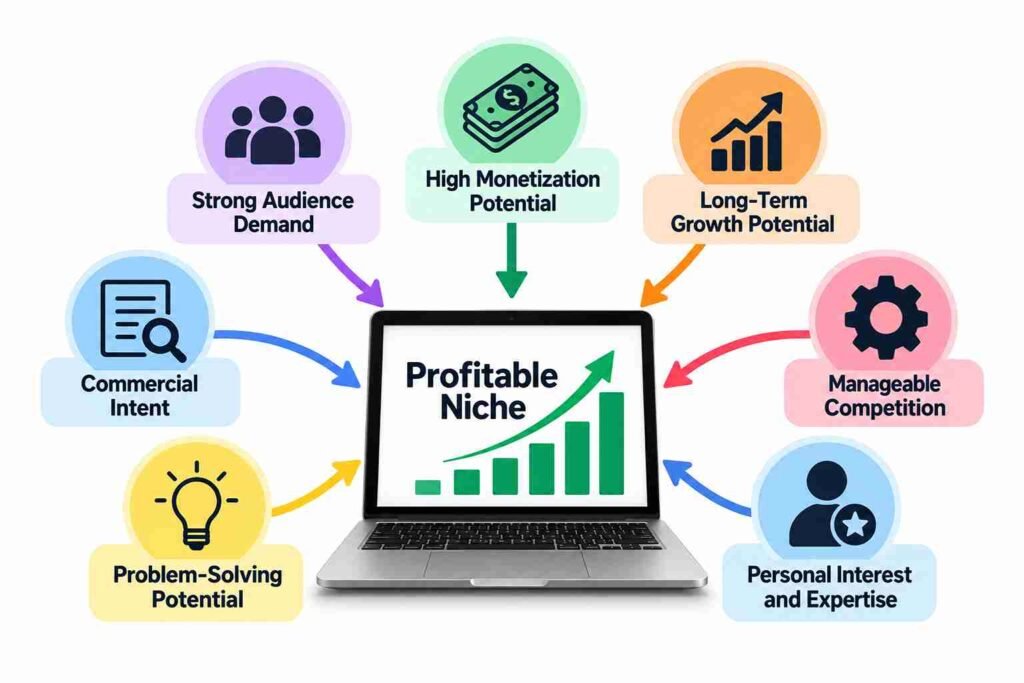
Before examining individual niches, understand the criteria that separate an attractive opportunity from a risky one.
| Factor | What to investigate | Why it matters |
|---|---|---|
| Audience demand | Search queries, forums, communities, recurring questions | Indicates whether people need the information |
| Commercial intent | Product comparisons, service searches, purchasing questions | Reveals potential buying activity |
| Monetization options | Ads, affiliate offers, services, products, sponsorships | Reduces dependence on one income source |
| Competition | Ranking websites, content quality, authority, search intent | Helps identify realistic entry points |
| Content depth | Number of useful subtopics and unanswered questions | Supports long-term editorial planning |
| Personal fit | Knowledge, interest, experience, access to expertise | Makes sustained publishing more practical |
| Trust requirements | Accuracy, credentials, testing, disclosures | Influences credibility and risk |
| Business costs | Hosting, software, research, production, promotion | Helps determine actual profitability |
No single factor should determine your decision.
High search volume does not guarantee revenue. High advertising rates do not guarantee substantial earnings. Low competition does not necessarily indicate a valuable opportunity, because demand may also be low.
The strongest niche is one where audience needs, commercial opportunities, content differentiation, and your ability to serve readers overlap.
15 Profitable Blogging Niches to Consider
The following niches offer different combinations of audience demand, monetization options, and content opportunities. They are candidates for research, not a verified ranking by earnings. Actual results vary by country, language, audience, competition, and execution.
1. Personal Finance and Money Management
Personal finance covers budgeting, saving, debt management, banking, investing education, insurance concepts, and financial planning.
Readers often seek practical answers to important questions, such as how to organize their monthly budget, compare bank accounts, understand credit scores, or prepare for major expenses.
Potential monetization methods include relevant affiliate programs, advertising, sponsorships, financial templates, budgeting spreadsheets, and educational products.
| Why it can work | Financial problems recur throughout people’s lives, creating opportunities for useful evergreen content. |
|---|---|
| Challenges | Competition is substantial, and inaccurate information can cause serious harm. Financial topics often fall within Google’s high-trust, high-impact content considerations. Build credibility through transparent authorship, reliable evidence, clear limitations, and qualified review where appropriate. Avoid guaranteed-return claims or personalized financial recommendations beyond your competence. |
Possible article ideas include beginner budgeting methods, emergency fund planning, explanations of compound interest, and comparisons of financial tracking tools.
2. Technology and Software
Technology blogs explain software, devices, online services, troubleshooting, and emerging tools.
A focused software blog might help freelancers select project management applications, small businesses automate routine tasks, or creators compare video editing tools.
Monetization options include software affiliate programs, sponsorships, advertising, product demonstrations, paid templates, and consulting.
| Why it can work | Businesses and individuals frequently need help choosing, configuring, and troubleshooting digital products. |
|---|---|
| Challenges | Software changes quickly, and generic product summaries are easy to replicate. Hands-on testing, screenshots, original comparisons, and clear explanations of limitations can make your content more useful. |
A good starting point is to choose a particular user group and solve its technology problems instead of attempting to cover every product category.
3. Blogging, SEO, and Digital Marketing
This niche helps people build websites, attract visitors, improve rankings, develop content strategies, and monetize online businesses.
It is particularly suitable for publishers who enjoy research, experimentation, website management, and explaining technical concepts in accessible language.
Potential income sources include advertising, hosting and software affiliates, sponsored content, SEO services, courses, templates, and consulting.
| Why it can work | Website owners need ongoing help with keyword research, technical SEO, content planning, analytics, and monetization. |
|---|---|
| Challenges | The niche is competitive, advice can become outdated, and exaggerated earnings claims undermine trust. |
For BlogEarns.com, this is a natural area of focus. Your existing content around keyword research, internal linking, technical SEO, on-page SEO, and website tools provides a foundation for a connected content ecosystem.
You can expand that ecosystem with guides to choosing a niche, validating content ideas, planning an editorial calendar, building topic clusters, and evaluating blogging expenses.
4. Web Hosting, WordPress, and Website Building
This niche helps beginners and businesses create websites, select hosting providers, choose themes, configure plugins, improve security, and troubleshoot common problems.
Monetization can include hosting referrals, theme and plugin affiliate programs, sponsored reviews, website maintenance, setup services, and educational products.
| Why it can work | Website owners often need several related products and services as their websites grow. |
|---|---|
| Challenges | Competition is strong, technical information changes, and commercial incentives can bias recommendations. |
Build trust by explaining who a product is suitable for, what it costs, which limitations matter, and what alternatives exist. If you review software or hosting, distinguish actual testing from research based on publicly available information.
BlogEarns can develop this niche through beginner tutorials, theme comparisons, hosting explainers, plugin guides, and practical troubleshooting articles.
5. Health, Fitness, and Wellness
Health and wellness includes exercise, healthy cooking, mobility, sleep habits, general wellness education, and fitness equipment.
Potential monetization sources include suitable affiliate products, fitness programs, advertising, sponsorships, books, and memberships.
| Why it can work | People continually seek practical ways to improve everyday habits and physical fitness. |
|---|---|
| Challenges | Health information must be accurate and appropriately qualified. Medical advice, treatment claims, and nutrition guidance can carry significant risks. Use reputable medical sources, seek qualified review for consequential claims, and avoid promising cures or guaranteed results. |
A focused site about beginner strength training or accessible home workouts may be easier to differentiate than a general health portal.
6. Travel and Tourism
Travel blogs cover destinations, itineraries, accommodation, transport, travel equipment, budgeting, and practical planning.
Potential income sources include hotel and activity referrals, travel insurance partnerships where appropriate, affiliate links, sponsorships, destination guides, and downloadable itineraries.
| Why it can work | Travellers research destinations and compare options before making bookings. |
|---|---|
| Challenges | Travel information can become outdated, competition is intense, and income may fluctuate with seasons or travel conditions. |
Personal photographs, realistic budgets, transport details, first-hand experiences, and clearly dated updates can distinguish a useful travel resource from a generic destination overview.
7. Food, Cooking, and Recipes
Food blogs provide recipes, cooking techniques, ingredient substitutions, meal plans, kitchen equipment recommendations, and dietary-specific cooking ideas.
Monetization can include advertising, sponsorships, affiliate links, recipe books, cooking classes, and meal-planning products.
| Why it can work | Food is an everyday need, and many readers return to trusted recipes repeatedly. |
|---|---|
| Challenges | Recipe development, photography, testing, and accurate instructions require considerable work. Search competition is also high. |
A focused approach, such as affordable vegetarian meals, regional recipes, beginner cooking, or lunch preparation for busy workers, may offer a clearer audience than covering every cuisine.
8. Education and Online Learning
Education blogs cover study techniques, learning resources, professional certifications, language learning, educational technology, and career development.
Potential monetization methods include relevant affiliate programs, tutoring, downloadable study materials, courses, memberships, and sponsorships.
| Why it can work | Learners often need explanations, structured study plans, and recommendations for educational resources. |
|---|---|
| Challenges | Accuracy and usefulness matter more than simply publishing large quantities of material. Examination dates, curricula, and certification requirements should be verified and updated when necessary. |
A niche that serves a clearly defined learner, such as beginner Excel users or people preparing for a particular professional certification, can support a structured collection of tutorials.
9. Careers, Jobs, and Professional Development
Career blogs help readers find employment, prepare for interviews, improve resumes, understand workplace expectations, and develop professional skills.
Monetization possibilities include job-board partnerships, resume services, career coaching, relevant training referrals, advertising, and digital templates.
| Why it can work | Career development is an ongoing need for students, job seekers, and working professionals. |
|---|---|
| Challenges | Job listings and recruitment announcements can become outdated quickly. Official notifications should be the primary source for vacancies, eligibility criteria, application deadlines, and recruitment procedures. |
A differentiated career blog might specialize in entry-level jobs, remote work skills, interview preparation, or a specific professional sector.
10. Home Improvement and Interior Design
This niche covers room organization, decoration, DIY projects, furniture selection, storage solutions, gardening, and home maintenance.
Monetization options include home-product affiliates, sponsorships, advertising, design consultations, printable planners, and project guides.
| Why it can work | Readers frequently research products and practical ideas before improving their homes. |
|---|---|
| Challenges | Product recommendations need to be relevant, measurements and installation guidance must be accurate, and highly visual content can require significant production effort. |
Specific topics, such as small-bedroom organization, rental-friendly decor, or budget room makeovers, can attract readers with clear needs and budgets.
11. Parenting and Family Life
Parenting blogs cover family organization, child-friendly activities, educational resources, family travel, and practical household routines.
Monetization options include relevant product referrals, sponsorships, printable resources, books, and memberships.
| Why it can work | Families regularly seek practical solutions to changing needs. |
|---|---|
| Challenges | Personal circumstances differ, and sensitive topics require care. Medical, developmental, and safety-related claims should rely on credible sources and qualified expertise. |
A focused site about family meal planning, educational activities, or organization for busy parents can offer a clear editorial direction.
12. Pets and Animal Care
Pet blogs cover training, grooming, pet equipment, animal behavior, feeding basics, and responsible pet ownership.
Potential income streams include pet-product affiliates, sponsorships, advertising, downloadable training plans, and educational products.
| Why it can work | Pet owners seek guidance and frequently purchase supplies. |
|---|---|
| Challenges | Veterinary questions require particular care. Do not substitute general blog advice for professional diagnosis or treatment. |
A blog focused on dog training for first-time owners or indoor enrichment for cats may be easier to organize than an unfocused animal website.
13. Personal Productivity and Organization
This niche helps readers manage time, plan projects, build routines, organize tasks, and use productivity tools.
Monetization options include software affiliates, printable planners, digital templates, courses, memberships, and consulting.
| Why it can work | Readers look for ways to make daily work more manageable. |
|---|---|
| Challenges | Much of the available advice is repetitive. Original experiments, realistic examples, practical templates, and clear demonstrations can improve differentiation. |
Possible subniches include productivity for freelancers, organization for students, or project management for small teams.
14. Hobbies, Crafts, and Creative Skills
This category includes photography, knitting, drawing, music production, gardening, woodworking, and other practical hobbies.
Monetization may include equipment referrals, patterns, digital downloads, classes, memberships, and sponsorships.
| Why it can work | Hobbyists often want instruction, inspiration, and recommendations for tools or materials. |
|---|---|
| Challenges | Audience size varies considerably, and some subjects have limited commercial demand. |
Choose a hobby with enough useful beginner and advanced topics, and show the process through original photographs, examples, diagrams, or demonstrations.
15. Sustainable Living and Practical Eco-Friendly Choices
Sustainable living blogs explore energy efficiency, waste reduction, reusable products, repair, gardening, and lower-impact household decisions.
Potential income sources include appropriate affiliate partnerships, sponsorships, guides, workshops, and digital products.
| Why it can work | Readers may need practical help comparing products and changing household habits. |
|---|---|
| Challenges | Claims about environmental benefits require evidence. Avoid presenting marketing language as verified environmental performance. |
A focused site about energy-saving improvements for renters or low-waste household routines can combine practical advice with product comparisons.
Which Blogging Niches Are Best for Beginners?
There is not universally best niche for a new blogger. The right choice depends on your experience, available time, audience, budget, and preferred business model.
The following comparison is a qualitative starting point, not a measured profitability ranking.
| Niche | Possible income models | Beginner consideration |
|---|---|---|
| Blogging and SEO | Software affiliates, services, templates, ads | Suitable if you enjoy website research and experimentation |
| WordPress and hosting | Hosting referrals, themes, plugins, services | Useful for publishers who can create practical tutorials |
| Food and recipes | Ads, books, equipment referrals | Requires recipe testing and visual content |
| Home improvement | Product referrals, sponsorships, guides | Benefits from original projects and photographs |
| Education | Courses, tutoring, learning tools | Works well with subject knowledge and structured teaching |
| Personal productivity | Templates, software referrals, courses | Can begin with a narrow audience and practical resources |
| Finance | Ads, relevant referrals, products | Requires strong accuracy, trust, and careful research |
| Travel | Booking referrals, guides, sponsorships | First-hand experience and updated details are valuable |
A beginner should not select a niche only because established websites appear to earn substantial revenue. Those publishers may have years of experience, large audiences, commercial relationships, and substantial production budgets.
Instead, look for a subject where you can publish genuinely helpful content, learn faster than your competition expects, and build a recognizable point of difference.
Broad Niche vs. Micro-Niche: Which Should You Choose?
A broad niche covers a large subject. A micro-niche focuses on a more specific audience or problem.
For example:
- Broad niche: Technology.
- Focused niche: Business software.
- Micro-niche: Project management software for small marketing agencies.
Another example:
- Broad niche: Food.
- Focused niche: Vegetarian cooking.
- Micro-niche: Affordable vegetarian meal preparation for students.
A micro-niche can make your initial positioning clearer because it gives you a defined reader and a narrower set of problems to solve. It can also help you create relevant content clusters and test whether your audience responds.
However, going too narrow can limit growth. If a topic has little demand, few related questions, and almost no relevant products or services, the website may struggle to attract enough readers or revenue.
The best approach is often to start with a focused audience and expand into closely related subjects when evidence supports the move.
For example, a blog about WordPress security might later cover backups, performance, maintenance, hosting, and website recovery. These topics serve a related audience and fit a coherent site purpose.
How to Find a Profitable Blogging Niche Step by Step
Choosing a niche should be a research process, not a guessing game. Follow these steps before committing to a domain name, website design, or large content plan.
Step 1: Identify your knowledge and interests
Start by listing subjects you understand, enjoy learning about, or have practical experience with.
Ask yourself:
- Which questions do people regularly ask me?
- Which tools, services, or products do I understand well?
- What problems have I personally solved?
- Which subjects could I research and explain consistently?
- Can I access reliable expertise if the subject requires specialist knowledge?
You do not need to choose a topic solely because it is your favorite hobby. A professional skill or a problem you have solved repeatedly may offer stronger opportunities.
The objective is to identify subjects where you can produce more than generic summaries.
Step 2: Brainstorm potential audiences
A niche becomes easier to evaluate when you define the people it serves.
Instead of writing for “everyone who uses the internet,” consider beginner bloggers, freelancers, local business owners, students, parents, or first-time website owners.
Think about their goals, constraints, common mistakes, purchasing decisions, and questions.
For example, first-time bloggers may need help choosing hosting, setting up a website, researching keywords, writing useful articles, and understanding monetization. Each problem can become a content cluster.
Step 3: Validate search demand
Use keyword research to discover how people search for information in the niche.
Start with broad phrases and expand them into specific questions. For a website-building niche, these might include:
- How to start a WordPress website.
- Best hosting for a small business.
- How to speed up WordPress.
- How to choose a WordPress theme.
- How to fix common website errors.
Useful research resources include Google Trends, Google Keyword Planner, and Google Search Console for sites you own or manage.
Google Trends helps compare relative interest and seasonality. Keyword Planner provides keyword ideas and advertising-oriented estimates. Search Console shows how your existing pages perform in Google Search.
Do not treat any single tool as a complete measure of demand. Search-volume estimates can be approximate, and a low-volume question may still attract highly relevant readers.
For further learning, explore BlogEarns’ keyword research and SEO content.
Step 4: Examine search intent
Search intent is the reason behind a query. A reader may want to learn something, compare options, find a specific website, or make a purchase.
Consider these searches:
- “What is web hosting?” indicates an informational need.
- “Best web hosting for a small business” suggests comparison.
- “Hosting provider A vs. provider B” indicates evaluation.
- “Buy managed WordPress hosting” signals stronger purchasing intent.
A profitable blog usually needs a mixture of these content types. Informational articles can attract readers and establish trust, while comparison and buying guides can help readers make decisions.
However, commercial intent does not guarantee income. The content must answer the actual query, and any recommended product should be appropriate for the reader.
Step 5: Assess the competition
Search Google for your most promising keywords and examine the pages currently ranking.
Ask:
- Are the results dominated by major publishers or official websites?
- Do the articles answer the query clearly?
- Are important questions left unanswered?
- Is the information outdated?
- Do competing pages include original testing, examples, or useful visuals?
- Could you provide a more accurate, practical, or audience-specific answer?
Do not reject a niche simply because established websites rank for its broadest keywords. Look for narrower questions, specialized audiences, and opportunities to offer stronger information.
At the same time, avoid assuming that a weak-looking search result guarantees easy rankings. Search engines evaluate many factors, and a new website may need time to establish credibility.
Step 6: Investigate monetization opportunities
Identify potential revenue sources before investing heavily in content production.
Look for relevant affiliate programs, advertising possibilities, products readers might purchase, services they might need, and information they may value enough to buy.
Examine the actual terms of relevant programs, including eligibility, commission rules, payment conditions, and geographic restrictions.
For example, a software tutorial blog might earn from appropriate referrals while also selling setup services. A cooking blog could combine advertising with a cookbook or meal-planning templates.
Do not assume a program will accept your website or that its current commission rates will remain unchanged.
Step 7: Estimate the cost of operating the blog
Profit is not the same as revenue.
A simple business calculation is:
Net profit = Total revenue − Total business expenses
Expenses can include hosting, domains, software subscriptions, freelance writing, editing, design, email marketing, research tools, and promotional activities.
Your own time also has economic value. A blog that generates revenue but requires excessive unpaid labor may not be as attractive as its headline earnings suggest.
Estimate your costs conservatively, and avoid borrowing money based on speculative future traffic or affiliate income.
Step 8: Test your ability to create useful content
Before committing to a niche, outline 30 to 50 genuinely useful article ideas.
Can you create beginner tutorials, advanced guides, comparisons, troubleshooting articles, case studies, and original resources without repeating the same information?
If you run out of meaningful ideas after a handful of posts, the niche may be too narrow or your chosen angle may need refinement.
If you can develop a structured library of related articles, the niche may have enough depth for sustained publishing.
Step 9: Make a small, measurable commitment
Choose a manageable initial group of articles and publish them consistently. Use the results to learn which topics attract impressions, clicks, engagement, and relevant commercial interest.
Search performance can take time, so do not abandon a promising niche after a few days or weeks. Equally, do not continue indefinitely without evaluating the evidence.
Review performance periodically and improve content based on reader questions, search data, and the quality of your results.
How to Research a Niche Using Free Tools
You can conduct meaningful initial research without purchasing expensive SEO software.
- Google Trends: Compare topic interest over time, investigate regional differences, and identify seasonal patterns.
- Google Keyword Planner: Generate keyword ideas and examine approximate search demand. Remember that it was designed for advertising research, so its estimates are not guaranteed organic traffic.
- Google Search Console: Once your site has search data, review queries, impressions, clicks, click-through rates, and page performance.
- Google Search: Examine current results to understand intent, competing formats, official sources, and content gaps.
- Google autocomplete and related searches: Discover natural query variations and questions that readers may ask. Treat these as idea sources rather than definitive search-volume evidence.
- Online communities: Relevant forums, professional communities, and discussion platforms can reveal recurring problems that keyword tools may not explain in detail.
- Competitor websites: Study article organization, audience focus, product coverage, and gaps in the available information. Use this research to develop original work rather than copying competing content.
For additional help, explore BlogEarns’ SEO-related resources and blogging guides.
How to Evaluate and Score a Potential Niche
When several niches appear promising, score each one against the same criteria. This makes comparisons more consistent and helps reveal where your assumptions need further research.
Use a score from 1 to 5 for each factor.
| Evaluation criterion | Weight |
|---|---|
| Audience demand | 20% |
| Monetization potential | 20% |
| Competition and entry opportunities | 15% |
| Personal knowledge or access to expertise | 15% |
| Content depth | 10% |
| Ability to differentiate | 10% |
| Long-term relevance | 10% |
| Total | 100% |
To calculate the weighted score, divide each rating by five, multiply it by the corresponding weight, and add the results.
For example, if a niche scores 4 out of 5 for audience demand, its contribution to the final score is 16 out of 20, or 16 points on a 100-point scale.
This is a planning framework, not a validated predictor of future earnings. The ratings are your judgments and should be supported by research wherever possible.
A niche with excellent commercial potential but poor personal fit may be difficult to maintain. Another with moderate commercial potential and a clear audience advantage may be more realistic for a beginner.
Use the score to structure your thinking, not to replace it.
How to Monetize a Profitable Blogging Niche
Selecting a suitable niche is only the beginning. Your revenue model determines how the website can turn useful content and audience attention into a sustainable business.
Display advertising
Display advertising generates revenue when eligible advertising is shown on your website. Actual earnings depend on factors such as traffic, audience location, advertiser demand, page quality, and ad placement.
Advertising can work well for sites with substantial relevant traffic, but it should not be the only business model you consider.
If you use Google AdSense, follow its official publisher policies. Violations can restrict advertising or lead to account enforcement.
Affiliate marketing
Affiliate marketing allows publishers to earn commissions when readers make qualifying purchases or complete specified actions through tracked referral links.
It can fit niches involving software, hosting, equipment, education, travel, and other relevant products.
The strongest affiliate content helps readers choose appropriately. Explain the intended audience, meaningful features, limitations, costs, and alternatives.
Disclose financial relationships clearly and close to relevant recommendations. The Federal Trade Commission’s endorsement guidance explains how disclosures should help consumers understand commercial relationships. Publishers should also check the rules applicable to their own jurisdiction and audience.
Sponsored articles and brand partnerships
Companies may pay to reach a relevant audience through sponsored articles, product demonstrations, newsletters, or other agreed content.
The commercial value depends on audience relevance, engagement, trust, and the quality of the publisher’s work, not merely its visitor count.
Sponsored content should be clearly identified, and paid links should be handled according to applicable search engine guidelines and legal requirements.
Digital products
Digital products can include ebooks, templates, spreadsheets, checklists, printable planners, tutorials, and online courses.
They can be particularly suitable when readers repeatedly encounter the same problem and need a practical resource.
For example, a blogging website could sell an editorial calendar, a website launch checklist, or a structured keyword research workbook.
Validate demand before investing heavily in product development. Start with a small resource that addresses a specific problem and improve it using feedback.
Services and consulting
A blog can also attract customers for writing, web design, technical support, SEO consulting, coaching, or other services.
Services may generate revenue with a smaller audience than advertising requires, but they depend on your expertise, time, pricing, and ability to find and serve clients.
Clearly define the scope of your service and avoid promising results you cannot control.
Memberships and subscriptions
A membership can provide premium resources, specialized tutorials, community access, or regularly updated material.
This model works best when the audience has an ongoing need and receives enough continuing value to justify recurring payments.
Do not launch a subscription simply because recurring revenue sounds attractive. First establish that readers want a resource or service worth paying for repeatedly.
Combine income sources thoughtfully
A diversified blog may earn from several compatible sources, but adding every possible monetization method can make the website confusing.
Choose methods that support the reader’s goals. A useful tutorial may naturally include a relevant tool recommendation, while a downloadable template may solve the next problem a reader faces.
The objective is to create a sustainable relationship between helpful content and appropriate commercial offers.
How to Build a Content Strategy Around Your Niche
A profitable niche becomes more valuable when you turn it into a coherent publishing plan.
Build topic clusters
Organize articles around core subjects. A website about blogging could have clusters covering niche research, website setup, content creation, SEO, and monetization.
Each cluster should answer related questions in a way that helps readers move from understanding a topic to applying it.
A pillar article provides the broad overview, while supporting articles address individual questions in greater depth.
Match articles to search intent
Create different types of content for different stages of the reader’s journey.
- Beginner guides explain concepts and processes.
- Tutorials show readers how to complete a task.
- Comparisons help readers evaluate alternatives.
- Reviews examine specific products or services.
- Case studies present evidence from actual projects.
- Templates and tools help readers apply what they learn.
A healthy editorial plan includes the formats that genuinely serve your audience rather than forcing every keyword into the same article structure.
Prioritize useful, original content
Google’s guidance on helpful, reliable, people-first content encourages publishers to create material that satisfies readers rather than content produced primarily to manipulate rankings.
Add value through firsthand experience, accurate explanations, original examples, useful testing, credible evidence, or a clearer approach to solving a problem.
Publishing more articles is not automatically better than publishing fewer, more useful ones.
Create a realistic publishing schedule
Choose a schedule that matches your resources. One thoroughly researched article per week may be more sustainable than publishing daily content that receives little review.
Plan time for research, editing, visuals, internal linking, technical checks, and updating older articles.
A content calendar should support consistency without turning publishing into a race to fill the website.
How Internal Linking Helps a Profitable Blogging Website
Internal links connect relevant pages on your own website. They help readers discover related resources and help search engines understand relationships between pages.
For a pillar article about choosing a niche, useful internal links could point to keyword research tutorials, low-competition keyword guides, SEO checklists, monetization articles, and website setup tutorials.
Use descriptive anchor text that accurately explains the destination. Link when the destination provides additional value, not simply to increase the number of links on the page.
A practical internal linking structure includes:
- A pillar article that introduces a major topic.
- Supporting articles that explore individual subtopics.
- Contextual links between closely related supporting pages.
- Links back to the pillar where it offers readers a useful broader explanation.
Avoid broken links, repetitive keyword-heavy anchors, and unnecessary links that interrupt reading.
For more practical advice, explore BlogEarns’ internal linking resources.
Common Mistakes to Avoid When Choosing a Blogging Niche
Choosing a niche only because it appears profitable
A popular niche can attract experienced competitors with substantial resources. Revenue screenshots and income claims do not establish that a new website can reproduce the same results.
Research demand, competition, costs, and your own ability to differentiate before committing.
Targeting too many unrelated subjects
A blog covering recipes, cryptocurrency, gardening, celebrity news, and website development may struggle to establish a clear editorial identity unless it has a compelling, coherent purpose.
A focused site can still expand, but new topics should make sense for its audience.
Selecting a niche with no clear monetization path
Some subjects attract interest without offering obvious commercial opportunities. That does not make them worthless, but it does mean you should identify a realistic business model before investing heavily.
Publishing generic, repetitive content
Repeating information already available elsewhere provides little reason for readers to choose your website.
Use original examples, meaningful research, practical demonstrations, and clear explanations to improve the usefulness of your articles.
Depending entirely on search traffic
Search engines are valuable discovery channels, but rankings and traffic can change. Build additional ways to reach your audience through an email newsletter, relevant communities, social platforms, and returning visitors.
Ignoring maintenance and changing information
Product prices, software features, official policies, and technical instructions can change. Review important pages periodically and update them when there is a meaningful reason to do so.
Neglecting trust and disclosures
Readers need to understand who created your content, what evidence supports important claims, and whether commercial relationships influence recommendations.
Transparent authorship, clear affiliate disclosures, accurate information, and responsible product reviews help protect reader trust.
A 90-Day Plan to Validate Your Blogging Niche
The first three months can be used to establish a foundation and collect early evidence. They should not be treated as a guaranteed timetable for ranking or earning money.
Days 1–15: Research and select
- Brainstorm three to five potential niches.
- Identify specific audiences and recurring problems.
- Research keywords, search intent, and competitors.
- Investigate relevant monetization methods.
- Estimate operating costs and choose a realistic niche.
Target outcome: A clear niche statement, an audience profile, and a documented rationale for your choice.
Days 16–30: Build the foundation
- Choose a suitable domain and blogging platform.
- Set up a usable, mobile-friendly website.
- Create essential navigation and trust pages.
- Configure analytics and Google Search Console.
- Develop a content map with pillar topics and supporting articles.
Target outcome: A functional website with a coherent editorial direction.
Days 31–60: Publish and improve
- Publish a focused group of high-quality articles.
- Connect relevant pages with contextual internal links.
- Add useful visuals, examples, and appropriate external references.
- Share content with relevant audiences.
- Improve articles based on reader feedback and research.
Target outcome: An initial content library that addresses real audience needs.
Days 61–90: Evaluate the evidence
- Review Search Console impressions, clicks, queries, and page performance.
- Identify topics attracting relevant attention.
- Investigate pages that receive impressions but few clicks.
- Check for indexing, usability, and technical problems.
- Review monetization opportunities and operating expenses.
- Refine your next content priorities.
Target outcome: A more informed decision about which topics to expand, which articles to improve, and where the website needs additional work.
Some new blogs will have limited search data after 90 days. That is not enough evidence by itself to declare a niche successful or unsuccessful. Use the available signals alongside the quality of your content, competitive position, and long-term business goals.
Frequently Asked Questions About Profitable Blogging Niches
| What is the most profitable blogging niche? |
|---|
| There is no universally most profitable blogging niche. Finance, software, technology, business, education, health, and other subjects may support different income models, but actual earnings depend on audience demand, competition, trust, monetization, costs, and execution. Choose a niche that has credible business opportunities and that you can serve effectively. |
| Which blogging niche is best for beginners? |
| A beginner-friendly niche is one with a clear audience, manageable research requirements, sufficient content depth, and realistic monetization options. Blogging tutorials, a specialized hobby, educational resources, productivity, and focused website-building guides may suit people who have relevant knowledge or are willing to develop it. |
| Can I start a profitable blog with no money? |
| You can begin learning and testing content ideas with free tools and low-cost publishing options. However, a sustainable blog may eventually require spending on a domain, hosting, software, research, or content production. Free tools reduce initial expenses but do not eliminate the time and effort needed to build an audience. |
| How long does it take for a blog to become profitable? |
| There is no reliable universal timeline. Some websites may earn early revenue through existing audiences or services, while others take considerably longer to attract meaningful traffic and income. Results depend on the niche, content quality, competition, distribution, monetization model, and operating costs. Do not plan your finances around guaranteed blogging income. |
| Is a low-competition niche always profitable? |
| No. Low competition may indicate an opportunity, but it may also reflect weak demand, limited purchasing activity, or an audience that is difficult to reach. Investigate demand and monetization alongside competition. |
| Should I choose a broad niche or a micro-niche? |
| A focused niche is often easier to position and organize at the beginning. A broad niche offers more expansion opportunities but can require more resources and a stronger editorial identity. Start with a clear audience and expand into related topics when you have evidence that the expansion serves readers. |
| Can I change my blogging niche later? |
| Yes, but consider how the change affects your existing audience, content, links, and website identity. A gradual expansion into related subjects is often easier to manage than an abrupt move into unrelated topics. Before deleting or redirecting established pages, assess their traffic, backlinks, usefulness, and role in the site’s structure. |
| Is affiliate marketing better than display advertising? |
| Neither is universally better. Advertising can monetize eligible page views, while affiliate marketing depends on relevant recommendations and qualifying actions. The best choice depends on your audience, traffic, commercial intent, product relevance, and willingness to maintain relationships and disclosures. |
| How many articles should I publish before monetizing my blog? |
| There is no fixed article count that guarantees eligibility or earnings. Some monetization methods depend on program-specific requirements, audience size, or the quality and suitability of your website. Focus on publishing useful content, building trust, and understanding the requirements of each monetization program rather than pursuing an arbitrary number of posts. |
| Is blogging still worth starting? |
| Blogging can still be a worthwhile way to build an audience, share expertise, attract customers, and create digital assets. However, success is not automatic, and competition, changing search behavior, and content production costs should be considered. A blog is more likely to become a sustainable business when it solves real problems, provides distinctive value, and has a realistic strategy for reaching and serving readers. |
Final Thoughts: Choose a Niche You Can Build a Business Around
Finding a profitable blogging niche is not about chasing a topic that promises the highest income. It is about identifying an audience with meaningful needs and developing a website that can meet those needs better, more clearly, or more specifically than available alternatives.
Begin with your knowledge and interests, investigate audience demand, examine search intent, assess the competition, and identify suitable revenue models. Then build a content strategy that answers real questions and gives readers a reason to return.
For BlogEarns.com, the broader lesson is equally important: a successful blogging resource should connect niche research with practical keyword research, website setup, content creation, SEO, and monetization. These subjects work together to help readers move from an initial idea toward a more sustainable online business.
Choose your niche carefully, but do not spend forever trying to find a perfect one. Make a reasoned decision, publish useful work, evaluate the evidence, and improve your approach as you learn.
The most promising profitable blogging niche is one where real audience demand meets useful expertise, credible monetization, and a clear reason for readers to trust your website.