
How to Find Low Competition Keywords
Trying to rank a new website for broad keywords such as “SEO,” “digital marketing,” “best hosting,” or “WordPress” can feel like walking into a crowded stadium and trying to start a conversation from the back row.
The problem usually isn’t that your content is bad. The problem is that you’re targeting keywords where established websites already have years of content, backlinks, authority, brand recognition, and search visibility.
This is where low competition keywords become valuable.
Learning how to find low competition keywords allows you to discover search terms where a smaller or newer website has a more realistic opportunity to appear in Google Search. Instead of fighting established websites head-on, you can identify narrower topics that closely match what your audience actually wants to know.
However, low competition does not simply mean finding keywords with the lowest difficulty score in an SEO tool. A keyword can show a low numerical difficulty and still be difficult to rank for. Likewise, a keyword with moderate competition can sometimes be a better opportunity when your website has relevant topical authority and the search results are weak.
Google itself recommends creating helpful, reliable, people-first content and using the words people actually search for in appropriate parts of your pages.
So the real objective is not to find a magical list of “easy keywords.”
It is to find relevant search queries with enough demand, manageable competition, clear search intent, and a realistic ranking opportunity for your website.
Let’s look at how to do that.
What Are Low Competition Keywords?
Low competition keywords are search queries for which relatively few strong, highly relevant pages are competing for the same search intent.

For example, compare:
“SEO”
with:
“how to find low competition keywords for a new blog”
The first keyword is extremely broad. Someone searching for it could be looking for an SEO definition, an SEO agency, an SEO tool, a course, technical information, or almost anything else related to search engine optimization.
The second query is much more specific. The searcher has a clear problem and is looking for a particular solution.
That specificity can reduce competition.
This is why keyword research should not be reduced to a single difficulty number. You need to understand the actual search results and the intent behind the query.
Google’s SEO documentation also emphasizes anticipating the different words people may use to find information rather than worrying about inserting every possible keyword variation into a page.
Why Low Competition Keywords Matter for New Websites
Established websites can often compete for broad, high-volume keywords because they have accumulated authority and strong link profiles over time.
A new website generally doesn’t have that advantage.
If you launch a website today and immediately publish an article targeting “SEO,” you’re competing with enormous websites, established publications, software companies, agencies, educational websites, and countless specialized publishers.
That doesn’t mean you should avoid competitive topics altogether.
Instead, build your way toward them.
Suppose your main topic is SEO.
Rather than starting with:
SEO
you might begin with:
low competition SEO keywords
then:
how to find keywords with low competition
then:
keyword research for a new website
and eventually move into broader subjects such as keyword research, technical SEO, content strategy, and topical authority.
This approach creates a logical path from narrow topics to broader topics.
It also helps you build topical depth.
How to Find Low Competition Keywords: The Process
There isn’t one tool or trick that can uncover every low competition keyword.
A reliable process combines keyword discovery, search intent analysis, competition evaluation, SERP research, and your own website data.
Here’s how I approach it.
1. Start With a Broad Topic
Don’t begin by opening a keyword tool and randomly exporting thousands of keywords.
Start with a topic.
For a website about SEO, your starting topics might include:
- keyword research
- on-page SEO
- technical SEO
- link building
- Google Search Console
- content optimization
- organic traffic
- SEO tools
These are your seed topics.
For example, if your seed topic is keyword research, you can expand it into questions and problems people actually search for.
Think about searches such as:
“how to do keyword research”
“keyword research for beginners”
“how to find low competition keywords”
“how to find long-tail keywords”
“free keyword research tools”
“keyword research for a new website”
The goal at this stage isn’t to decide what you’ll publish.
It’s to create a pool of possibilities.
2. Think Like the Searcher
One of the easiest ways to discover low competition keywords is to stop thinking like an SEO professional for a moment.
Think like someone who needs an answer.
Imagine that you’ve just started a blog.
What might you search?
You might type:
“why is my new blog not getting traffic”
rather than:
“organic search acquisition strategy.”
A beginner might search:
“how to find keywords for my blog”
while an experienced marketer might search:
“keyword clustering methodology.”
Both searches concern similar concepts, but the language and intent are different.
This is why Google’s guidance about understanding the terms readers actually use matters.
Write down questions your audience would ask.
Those questions often become excellent long-tail keyword opportunities.
3. Look for Long-Tail Keywords
Long-tail keywords are usually more specific search phrases, often containing several words.
Examples include:
“best SEO tools for a small blog”
“how to find keywords for a new website”
“how to improve organic traffic from Google”
“how to find low competition keywords without paid tools”
Long-tail doesn’t automatically mean low competition.
That’s an important distinction.
Some long-tail queries are aggressively targeted by large websites because they have commercial value.
But specific queries often give you more information about the searcher’s intent, which makes them easier to evaluate.
A highly specific query can also allow you to create a page that answers exactly what the user wants.
That is much better than writing a giant generic article that tries to answer twenty unrelated questions.
4. Use Google Autocomplete
Google itself can be a useful keyword research source.
Start typing your seed keyword into Google and look at the suggestions.
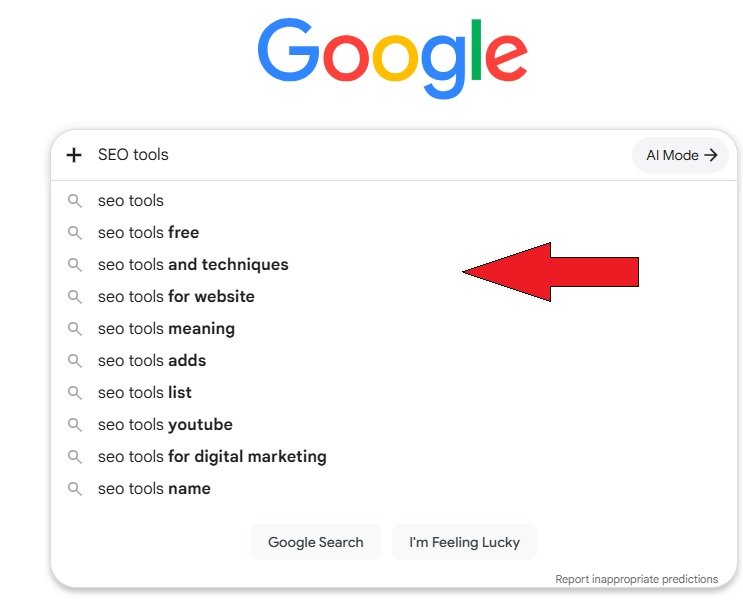
For example:
how to find low competition…
Google may suggest variations related to:
- keywords
- niches
- keywords for SEO
- keywords without tools
- keywords with high search volume
- keywords for a new website
These suggestions reflect real search behavior, although they should not be treated as guaranteed search-volume data.
You can also search your main topic and examine the “People also ask” questions.
These questions can reveal the problems Google believes are closely related to the topic.
Don’t simply copy every suggestion into an article.
Instead, look for recurring questions that represent distinct search intents.
5. Analyze the Search Results Before Choosing a Keyword
This is one of the most important steps in learning how to find low competition keywords.
Never choose a keyword solely because an SEO tool gives it a low difficulty score.
Search for the keyword yourself.
Look carefully at the first page.
Ask:
Are the ranking pages genuinely answering the query?
If the results are dominated by highly authoritative websites with extremely comprehensive content, strong brands, and pages specifically built around the query, the keyword may not be as easy as its difficulty score suggests.
On the other hand, you may find results such as:
- outdated articles
- thin content
- generic pages
- forum discussions
- poorly targeted articles
- pages that only partially answer the query
- articles from sites with little topical relevance
That can indicate a content opportunity.
The important word is can.
Weak competitors don’t guarantee a ranking.
Google’s systems evaluate many signals, and Google explicitly emphasizes helpfulness, reliability, originality, and satisfying the user’s needs.
6. Check Search Intent
Search intent is often more important than keyword volume.

Imagine you find this keyword:
“best keyword research tools.”
The searcher probably wants recommendations or comparisons.
Now compare it with:
“what is keyword research.”
That person probably wants an explanation.
These should normally be separate pages.
If you create an article that tries to rank for both without properly satisfying either intent, you may end up with a page that is too broad.
Before targeting a keyword, determine whether the searcher wants:
Information:
They want to learn something.
Commercial investigation:
They are comparing products, services, or options.
Transactional information:
They are getting closer to taking an action.
Navigational information:
They are looking for a specific website or brand.
The closer your content matches the intent, the more useful the page becomes.
7. Use Keyword Difficulty, But Don’t Worship It
Most professional SEO platforms provide a keyword difficulty or competition metric.
These metrics can be extremely useful for comparing thousands of keywords quickly.
But they are estimates.
Different tools calculate difficulty differently.
A keyword with a difficulty score of 15 isn’t automatically easy.
A keyword with a score of 35 isn’t automatically impossible.
Treat the number as one piece of evidence.
Your evaluation should combine:
Keyword difficulty + search intent + SERP quality + topical relevance + website authority + content quality.
That’s a much more reliable framework.
8. Look at Search Volume Carefully
Search volume tells you how frequently a keyword is searched according to the particular tool and its methodology.
It is useful, but don’t become obsessed with large numbers.
Suppose Keyword A has:
10,000 monthly searches
but extremely strong competition.
Keyword B has:
300 monthly searches
and you have a realistic opportunity to rank.
If you rank well for Keyword B and it attracts highly relevant visitors, it can become more valuable to a small website than Keyword A sitting on page five.
There is another advantage.
One well-targeted page can rank for many related queries.
Google Search Console allows you to see the queries that are showing your site in search results, along with clicks, impressions, CTR, and average position.
So don’t judge a page only by the keyword you originally targeted.
Your page may eventually rank for dozens or hundreds of related searches.
9. Use Competitor Research to Find Keyword Gaps
Competitor research is one of my favorite ways to uncover opportunities.
Find websites that are similar to yours.
Then identify the topics they rank for that you haven’t covered yet.

Suppose a competitor has an article targeting:
“how to find keywords for a new website.”
You might discover that the same page receives impressions for related searches such as:
- keyword research for new websites
- keywords for new blogs
- SEO keywords for new websites
- low competition keywords for beginners
Now you have a starting point for your own content research.
But don’t simply rewrite the competitor’s article.
Study what the current results provide and ask:
What would make my version genuinely more useful?
Maybe you can include a clearer process, screenshots, examples, a practical workflow, original observations, or a better explanation for beginners.
That’s the difference between content designed to copy search results and content designed to improve upon them.
10. Find Keyword Opportunities in Google Search Console
If your website already receives organic impressions, you have an enormous keyword research resource sitting inside your Search Console account.
Open the Performance report and go to Queries.
Google allows you to analyze queries by clicks, impressions, CTR, and average position.
Now look for queries where:
- impressions are growing
- your average position is around page one or page two
- clicks are relatively low
- the query is relevant to your website
- your existing page only partially addresses the topic
These are potential content opportunities.
For example, imagine you have an article about SEO basics.
Search Console might reveal impressions for:
“how to find low competition keywords”
but your existing article only mentions the concept briefly.
That is a strong signal that you could create a dedicated, substantially more useful article around the query.
Google’s Search Console documentation specifically recommends using query and page data to identify opportunities and improve search performance.
11. Don’t Ignore “Zero-Volume” Keywords
SEO tools sometimes show keywords with very low or even zero estimated monthly searches.
Many publishers immediately ignore them.
That’s not always wise.
A keyword with low reported volume can still generate traffic through related searches.
Search volume estimates are not a perfect measurement of every real-world search.
If the query represents a genuine problem faced by your audience and you can create a useful page around it, it may still be worth targeting.
The key is relevance.
Don’t create hundreds of pages around obscure phrases simply because you think they might generate traffic.
Google’s current guidance explicitly warns against producing lots of content primarily in the hope that some of it will perform in search.
12. Create Better Content Than the Current Results
Finding the keyword is only half the job.
The next question is:
Why should Google rank my article instead of the existing ones?
You need a convincing answer.
That doesn’t necessarily mean writing 5,000 words.
Google has explicitly said there is no preferred word count that creators should target.
A 1,500-word article that completely solves the user’s problem can be better than a 4,000-word article filled with repetition.
For a guide about low competition keywords, useful additions could include:
- real keyword examples
- a repeatable research process
- examples for new websites
- explanations of keyword difficulty
- search intent analysis
- competitor research
- Search Console methods
- free and paid research methods
- mistakes to avoid
- an actionable keyword evaluation framework
The reader should finish the article thinking:
“I know exactly what to do next.”
That’s a much better goal than simply reaching a particular word count.
A Simple Low Competition Keyword Formula
When evaluating a keyword, I recommend thinking about it using five questions:
Relevance:
Does this keyword directly relate to my audience?
Intent:
Can I clearly understand what the searcher wants?
Competition:
Are the current results dominated by exceptionally strong pages?
Opportunity:
Are there weaknesses in the current results that I can genuinely improve?
Value:
If I rank, will the visitor be useful to my website or business?
If the answer is yes across most of these areas, you’ve probably found a keyword worth investigating further.
Common Mistakes When Finding Low Competition Keywords
The first mistake is chasing the lowest possible difficulty score.
That often produces irrelevant keywords that don’t help your business.
The second mistake is targeting keywords purely because they have search volume.
Traffic without relevance is not a successful SEO strategy.
The third mistake is ignoring the SERP.
SEO tools can tell you useful things about a keyword, but the actual search results show you what Google is currently rewarding.
The fourth mistake is creating one enormous article to target every related keyword.
Sometimes several closely related keywords belong on one page. Sometimes they represent completely different search intents and deserve separate pages.
The fifth mistake is publishing the article and never checking what happens afterward.
SEO is an iterative process.
Your Search Console data can tell you what users are actually searching for and which queries your pages are appearing for.
How to Build a Low Competition Keyword Strategy for a New Website
If your website is relatively new, don’t try to conquer the biggest keywords immediately.
Start with specific, closely related topics.
Imagine you are building an SEO website.
Your first cluster could be:
How to Find Low Competition Keywords
Then supporting topics could include:
How to Find Long-Tail Keywords
Free Keyword Research Tools
How to Find Keywords for a New Website
Keyword Difficulty Explained
How to Analyze Keyword Competition
How to Use Google Search Console for Keyword Research
These articles can be connected through contextual internal links.
Once your website develops useful coverage around the subject, you can begin targeting broader topics.
How Many Low Competition Keywords Should You Target?
Don’t set a target such as “I need 100 low competition keywords this month.”
Set a better goal:
How many genuinely useful topics can I cover better than the existing results?
One strong article can rank for dozens of related queries.
Ten excellent pages covering a tightly related topic can be more valuable than fifty shallow articles spread across unrelated subjects.
Google’s people-first guidance specifically emphasizes having a clear site purpose, demonstrating expertise, and creating content that leaves visitors feeling they have learned enough to accomplish their goal.
That’s the mindset I would use when building a long-term SEO strategy.
Final Thoughts
Learning how to find low competition keywords isn’t about discovering secret keywords that nobody else knows.
Those keywords rarely exist in the way SEO shortcuts suggest.
The real advantage comes from finding specific, relevant searches where your website has a realistic opportunity to provide a better answer.
Start with a broad topic. Expand it into real questions. Look for long-tail variations. Analyze search intent. Check the actual Google results. Use keyword difficulty as a supporting metric rather than the final decision-maker. Study competitors. Then use Google Search Console to uncover additional opportunities once your content starts receiving impressions.
Most importantly, don’t create content simply because a keyword tool says the keyword is easy.
Create it because someone has a problem, question, or goal that your page can genuinely help with.
That’s the foundation of sustainable SEO.
And when you consistently combine relevant low competition keywords + strong search intent + useful content + internal linking + continuous optimization, a new website can gradually move from chasing traffic to building genuine search visibility.
Frequently Asked Questions About Low Competition Keywords
| What are low competition keywords? |
|---|
| Low competition keywords are search queries where a website has a realistic opportunity to rank because the current search results have relatively weak, less relevant, or less authoritative competition. Competition should be evaluated alongside search intent, content quality, topical relevance, and the actual Google search results rather than relying only on a keyword difficulty score. |
| How do I find low competition keywords? |
| Start with a broad topic and expand it into specific questions, long-tail phrases, and problem-based searches. Google Autocomplete, People Also Ask, related searches, competitor research, keyword research tools, and Google Search Console can all provide keyword ideas. After finding potential keywords, search them manually and examine the quality and relevance of the current top-ranking pages. |
| How can I find low competition keywords without paid tools? |
| You can find many opportunities without paying for an SEO platform. Use Google Autocomplete, People Also Ask, Related Searches, Google Search Console, Reddit, forums, and competitor websites to discover specific search queries. You can then manually review Google’s results to determine whether the keyword appears realistically achievable. People Also Ask is particularly useful for discovering question-based and long-tail keyword ideas. |
| Are long-tail keywords easier to rank for? |
| Long-tail keywords can be easier to target because they are generally more specific and often have clearer search intent. However, being a long-tail keyword does not automatically make a query easy to rank for. You should still check the search results, competition, relevance, and quality of the pages already ranking. |
| What keyword difficulty should I target for a new website? |
| There is no universal keyword difficulty score that guarantees an easy ranking. Many SEO professionals use a low difficulty threshold as an initial filter, but the actual search results should make the final decision. A keyword with a low difficulty score can still be difficult if highly authoritative and highly relevant pages dominate the SERP. |
| Can a keyword with zero search volume still be worth targeting? |
| Yes. A keyword showing zero or very low estimated search volume can still be valuable when it closely matches your audience’s needs. Search-volume estimates vary between tools, and one page can rank for many related queries. The important question is whether the topic has genuine relevance and whether your content can satisfy a real search intent. |
| How do I find low competition keywords on Google? |
| Enter your main topic into Google and examine Autocomplete suggestions, People Also Ask questions, Related Searches, and the pages ranking for your query. Look for specific questions or phrases where the current results are outdated, poorly matched to the intent, thin, or otherwise leave room for a more useful answer. |
| How do I use Google Search Console to find low competition keywords? |
| Open the Performance report in Google Search Console and review the queries generating impressions for your website. Look for relevant queries where your pages already appear but receive relatively few clicks, particularly queries where you are close to the first page. These terms can reveal opportunities to improve an existing page or create a dedicated resource. |
| Are low competition keywords better than high-volume keywords? |
| Not necessarily. Low competition keywords can provide more realistic opportunities for newer or smaller websites, while high-volume keywords can offer considerably more potential traffic but usually require stronger competition analysis and a more established site. A balanced SEO strategy should gradually target both specific opportunities and broader topics. |
| How many low competition keywords should I target in one article? |
| Focus on one primary search intent rather than trying to insert dozens of unrelated keywords into the same article. You can naturally cover closely related terms, questions, and variations within the page. If a keyword represents a substantially different search intent, it may deserve its own article instead. |
| What is the easiest way to find keyword gaps from competitors? |
| Find websites that are relevant to your niche and reasonably comparable to your own site. Analyze the topics and keywords they rank for, then identify subjects that your website does not cover. After that, evaluate the search intent and Google results before creating a page. The objective isn’t to copy a competitor’s content but to identify useful topics they have covered that your audience may also need. |
| Do low competition keywords guarantee Google rankings? |
| No. A low competition keyword does not guarantee a first-page ranking. Keyword difficulty metrics are estimates, and Google’s search results consider many factors. Your page still needs to provide useful, relevant, trustworthy content that satisfies the searcher’s intent. Even when a keyword looks easy, the final test is how well your content serves the query compared with the existing results. |