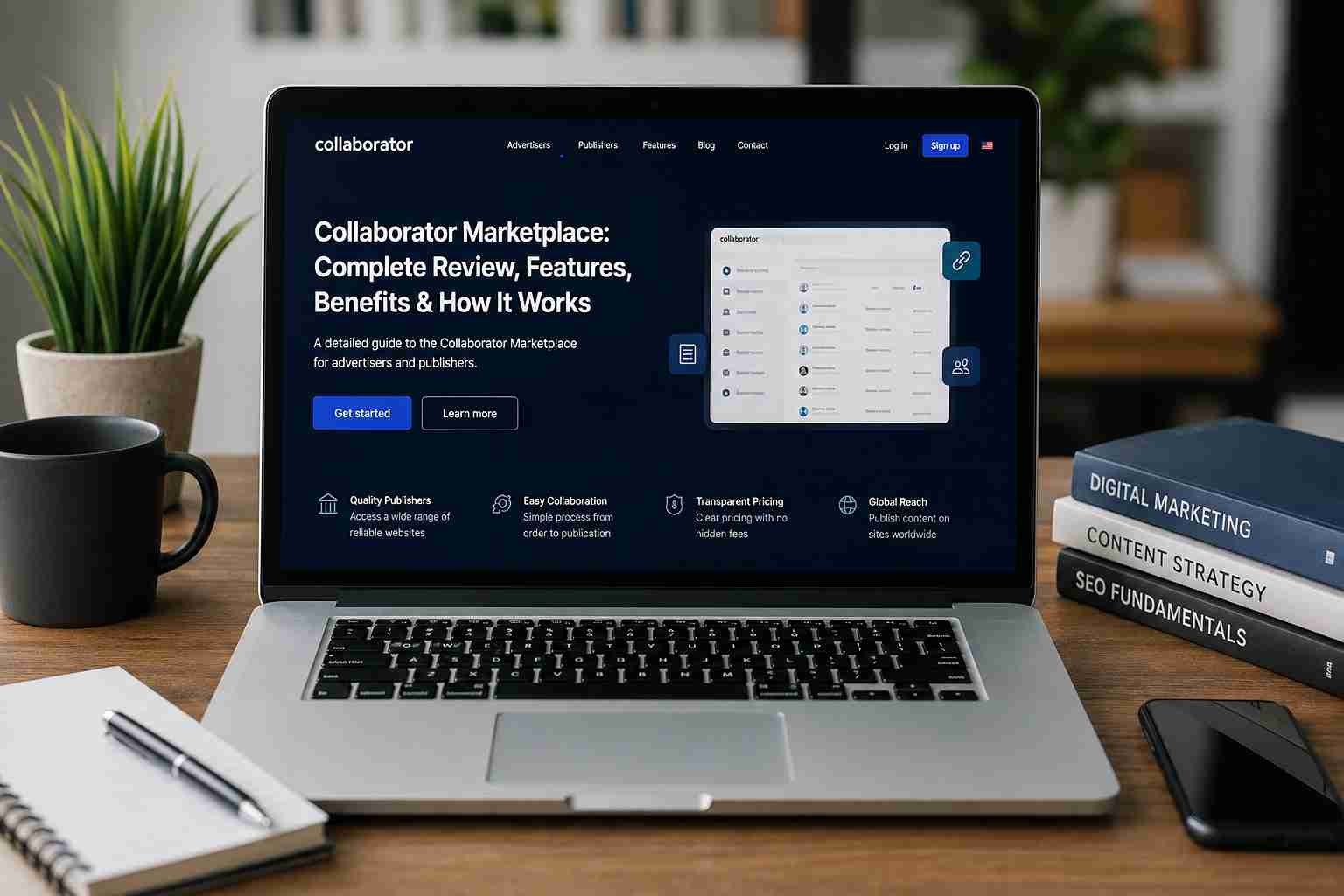
Collaborator Marketplace Review: Features, Pricing, Guest Posts and Link Building Guide
Link building, digital PR, and sponsored content distribution have traditionally involved a considerable amount of manual work.
An SEO professional or business owner would identify potential websites, search for contact information, send outreach emails, negotiate publication prices, wait for responses, verify traffic and website metrics, arrange payment, submit content, and then monitor whether the article and backlink remained live.
This process can work, but it is time-consuming.
The larger the campaign becomes, the more complicated the process can become.
This is where a platform such as Collaborator Marketplace enters the picture.
Collaborator, available through Collaborator Marketplace, is a digital PR and content distribution marketplace that connects advertisers with website publishers. Advertisers can search for websites and media opportunities where they want to publish content, while website owners can list their websites and monetize them by accepting paid guest posts and sponsored content opportunities. The marketplace also includes opportunities involving Telegram channels and related content distribution services.
At its core, Collaborator attempts to organize the relationship between two groups:
- Advertisers, including SEO specialists, agencies, marketers, PR professionals, and businesses that want to promote content.
- Publishers, including website owners, bloggers, media platforms, portals, and other content publishers that want to monetize their digital properties.
Instead of relying entirely on cold outreach, advertisers can browse a marketplace of available publishing opportunities.
Instead of spending time responding individually to countless outreach emails, publishers can list their websites and receive potential orders through a centralized system.
The concept is straightforward, but the platform’s value depends heavily on the quality of its marketplace, the information available about publishers, pricing transparency, transaction protection, filtering capabilities, and the quality of the individual websites advertisers select.
Collaborator has positioned itself as a global marketplace with a large catalog of websites and publishing opportunities. The exact number of available sites changes over time as publishers join, leave, or update listings, so marketers should always check the live catalog rather than relying on a permanently fixed number. Current official and third-party descriptions place the marketplace in the tens of thousands of websites, with additional Telegram publishing opportunities.
For anyone researching link-building marketplaces, Collaborator deserves attention because it offers a combination of self-service publisher discovery, SEO metrics, traffic information, filtering options, order management, content placement, and publisher monetization.
However, an important distinction should be made immediately:
A link-building marketplace is a discovery and transaction platform. It does not automatically guarantee that every website available on the marketplace is a high-quality placement for every campaign.
The responsibility for evaluating individual websites remains with the advertiser.
That distinction is essential when using Collaborator or any other guest posting marketplace.
What Is Collaborator.pro?
Collaborator.pro is a marketplace designed to facilitate paid content publication and digital PR campaigns.
An advertiser can search the marketplace for a website that matches a campaign’s requirements and submit an order for publication.
The order may involve:
- A guest post
- Sponsored content
- A brand mention
- A content placement
- A backlink within published content
- PR-oriented publication
- Content distribution through a relevant publisher
- In some cases, additional promotional options offered by the publisher
The publisher receives the order, reviews the requirements, and publishes the content if the order is accepted and completed according to the agreed conditions.
The marketplace therefore acts as an intermediary between advertisers and publishers.
According to Collaborator’s own FAQ and platform descriptions, the service provides website discovery, publisher filtering, traffic and SEO information, feedback systems, transaction protection, content-related services, and link protection options. The platform also states that its catalog includes different types of publishers, including informational websites, media outlets, blogs, portals, and other publishing properties.
For advertisers, the primary attraction is efficiency.
Instead of beginning every campaign with a blank spreadsheet and hundreds of cold emails, a marketer can search within an existing catalog.
For publishers, the primary attraction is monetization.
Instead of waiting for advertisers to discover the website independently, the publisher can become visible to businesses and agencies searching for content placement opportunities.
This marketplace model has become increasingly popular because it reduces some of the operational friction associated with traditional outreach.
However, reducing friction does not remove the need for due diligence.
The marketplace makes it easier to find opportunities.
It does not eliminate the need to determine whether those opportunities are genuinely valuable.
How Does Collaborator Marketplace Work?
The general workflow on Collaborator is relatively straightforward.
An advertiser first creates an account and sets up a project or campaign context.
The advertiser can then search the marketplace catalog and use available filters to identify websites that may match the campaign.
Once a suitable website has been identified, the advertiser can add it to the order process and provide publication requirements.
The publisher then receives the request.
Depending on the publisher’s conditions and the marketplace workflow, the publisher may accept the order and publish either advertiser-provided content or content prepared through an available writing service.
Collaborator describes the advertiser workflow as beginning with registration, selecting websites from the catalog, submitting publication requirements, and monitoring the publication process after the publisher completes the order.
The process can be understood through five broad stages.
Stage One: Finding a Publisher
The advertiser searches for websites relevant to the campaign.
This stage is arguably the most important.
The marketplace may contain thousands of options, but only a small percentage will necessarily be appropriate for a specific website, topic, or audience.
A good campaign should prioritize relevance.
For example, a cybersecurity software company should generally prefer a technology, cybersecurity, SaaS, or business publication over a completely unrelated entertainment website, even if the entertainment website displays stronger surface-level authority metrics.
Stage Two: Evaluating the Website
After identifying a possible website, the advertiser should review available information.
Depending on the listing and platform data, this may include factors such as:
- Topic or category
- Geographic relevance
- Traffic information
- SEO metrics
- Publisher reviews
- Publication conditions
- Placement pricing
- Content requirements
- Additional services
The marketplace’s official information emphasizes its filtering capabilities and the availability of traffic and SEO-related data from multiple data providers.
Stage Three: Creating the Order
The advertiser selects the placement and submits the publication request.
The request should clearly define:
- The article topic
- Content requirements
- Desired publication format
- Target URL
- Anchor text requirements
- Any disclosure or promotional requirements
- Other relevant editorial instructions
A well-written brief can reduce misunderstandings and make the publication process smoother.
Stage Four: Publication
The publisher reviews and completes the order.
The article may be published using content supplied by the advertiser or through an available writing option.
The advertiser should verify the completed publication before treating the order as fully successful.
Verification should include checking:
- Whether the article is live
- Whether the correct URL is included
- Whether the anchor text is correct
- Whether the article is indexable where appropriate
- Whether the placement follows the agreed requirements
- Whether the content appears on the expected domain and page
Stage Five: Monitoring
The work does not necessarily end when the article goes live.
- Marketers should monitor important placements over time.
- Links can be changed.
- Pages can be removed.
- Websites can lose traffic.
- Search visibility can decline.
A placement that looked valuable at the time of purchase may change in value later.
Collaborator states that it offers a basic period of protection against link deletion and also provides an option for extended protection, subject to the platform’s applicable terms.
Who Can Use Collaborator Marketplace?
Collaborator can be useful for several types of users.
SEO Professionals
SEO professionals may use the marketplace to identify content placement opportunities for clients or their own websites.
The main advantage is the ability to search for potential publishers using marketplace filters rather than conducting every stage of publisher discovery manually.
However, SEO professionals should evaluate placements based on more than Domain Rating or Domain Authority.
A high metric alone does not automatically indicate editorial value.
SEO Agencies
Agencies managing multiple clients may find marketplaces particularly useful because manual outreach can become operationally expensive.
An agency may need placements for different industries, countries, languages, and campaign objectives.
A large searchable catalog can simplify the discovery process.
Current third-party reviews describe Collaborator as particularly suited to agencies that want outlet-level selection and a self-service model without a recurring marketplace subscription.
PR Professionals
Public relations teams can use content placement marketplaces to distribute business stories, announcements, case studies, and brand content.
For PR campaigns, the value of a publication may extend beyond SEO.
The campaign may focus on:
- Brand awareness
- Referral traffic
- Media visibility
- Industry positioning
- Reputation building
- Audience reach
This is an important perspective because not every placement should be evaluated solely according to backlink metrics.
Businesses
Small and medium-sized businesses may use Collaborator to access publishers they might otherwise struggle to contact.
For businesses without a dedicated outreach team, the marketplace can reduce the amount of manual work required to discover potential publishing opportunities.
Website Owners and Bloggers
Publishers can use Collaborator to monetize their websites.
According to the platform’s publisher information, the process involves creating an account, adding a website to the catalog, receiving and accepting advertiser orders, publishing content, and requesting payment after the work is completed.
This makes Collaborator relevant not only as a link-building marketplace but also as a potential blog monetization channel.
Key Features of Collaborator Marketplace
The value of any marketplace depends on its operational features.
Collaborator provides several features intended to help advertisers identify, evaluate, and manage content placement opportunities.
Large Publisher Catalog
One of Collaborator’s major attractions is the scale of its publisher catalog.
The marketplace is described across current sources as containing tens of thousands of websites, although the exact number varies as the catalog changes. The platform also includes Telegram publishing opportunities and other content distribution options.
Scale is useful because different campaigns require different types of publishers.
A business targeting Germany may need German-language publishers.
A SaaS company may need technology websites.
A local company may need geographically relevant publications.
A global brand may need multilingual opportunities.
A larger catalog increases the probability of finding specialized opportunities.
But quantity should never be confused with quality.
A catalog containing 40,000 websites does not mean 40,000 websites are suitable for your campaign.
Filtering and evaluation remain critical.
Advanced Filtering
A large marketplace without effective filters can become overwhelming.
Collaborator highlights filtering by factors such as topic, geography, traffic, placement characteristics, and SEO metrics.
The ability to filter a large database is valuable because relevance should usually be the first screening criterion.
A practical filtering workflow might begin with:
Topic relevance → Country → Language → Traffic → Quality indicators → Price → Publisher reputation
This sequence can prevent marketers from becoming distracted by high authority metrics on irrelevant websites.
For example, if you are promoting an Indian education platform, beginning with education-related publishers relevant to India may be more useful than sorting the entire marketplace by the highest available authority metric.
Collaborator’s FAQ describes a range of filtering options that include website subject, geography, traffic, placement speed, and data from SEO tools.
Website Traffic and SEO Data
Traffic data is extremely useful when evaluating a publisher.
A website can have strong historical authority metrics while receiving little meaningful current traffic.
For this reason, advertisers should evaluate multiple indicators together.
Potential signals include:
- Organic traffic trends
- Traffic stability
- Geographic traffic distribution
- Topic relevance
- Keyword visibility
- Authority metrics
- Backlink profile
- Content quality
Collaborator states that its marketplace provides data verified or supported through integrations and data sources that include SEO tools and analytics systems, depending on the website listing and available verification.
No single metric should control the purchasing decision.
A healthy website evaluation process considers multiple signals.
Publisher Reviews and Feedback
Marketplace reviews can help advertisers understand how previous collaborations have gone.
A publisher with consistently positive feedback may demonstrate reliable order completion and communication.
However, reviews should be considered alongside objective website evaluation.
A publisher may be excellent at communication while still operating a website that is irrelevant to your campaign.
The ideal placement combines:
- Reliable publisher behavior
- Relevant website topic
- Real audience
- Appropriate editorial standards
- Reasonable pricing
Collaborator specifically highlights its feedback system as a way for advertisers to review previous experiences with publishers.
Content Writing Options
Some advertisers already have content prepared.
Others prefer the publisher or a marketplace service to prepare the article.
Collaborator provides options related to copywriting and publisher-specific content services. This can simplify campaigns where the advertiser wants the placement and content production managed through the same workflow.
However, content quality should still be reviewed carefully.
The fact that a writing service is available does not mean every piece of content will automatically match your brand voice or editorial requirements.
For important placements, businesses should provide a detailed brief.
Homepage and Additional Promotion Options
Some publishers may provide additional promotional options.
These can include homepage announcements or other forms of visibility depending on the publisher’s individual offering.
The value of such extras depends on the campaign objective.
If your goal is brand awareness and referral traffic, additional visibility may be valuable.
If your goal is solely a contextual editorial placement, an expensive promotional add-on may not provide proportional value.
Advertisers should therefore evaluate extras according to campaign goals rather than automatically purchasing every available option.
Collaborator Pricing: How Much Does It Cost?
One of the most important questions advertisers ask is:
How much does Collaborator cost?
The answer has two parts.
First, individual publication prices are generally determined by publishers.
This means there is no single universal guest post price across the marketplace.
A niche blog may charge a relatively low amount.
A well-established media website may charge significantly more.
Second, advertisers should consider applicable marketplace and transaction fees, as well as optional services such as content creation or extended placement protection.
Recent 2026 third-party analyses describe Collaborator as operating without a recurring subscription fee for marketplace access, with costs based on individual placements and applicable transaction charges. Current pricing analyses have described a 10% deposit commission for advertisers, although fees and payment terms can change and should always be confirmed directly on the platform before funding a campaign.
This is an important principle for any authority review:
Do not treat marketplace pricing as permanently fixed.
Fees, commissions, payment options, and publisher prices can change.
Before launching a campaign, check the live pricing and terms directly on Collaborator’s official platform
What Determines the Price of a Guest Post?
Publisher pricing may depend on many factors.
Website Authority
Publishers with stronger established metrics may charge more.
However, authority metrics should never be the only factor.
Organic Traffic
A website with substantial and stable relevant traffic may command higher pricing.
Traffic should also be analyzed geographically.
A website with 100,000 monthly visitors may be less useful if almost none of those visitors are in your target market.
Niche Relevance
Highly specialized websites may charge more because relevant placements are more difficult to obtain.
A niche healthcare, finance, technology, or legal publication may have greater commercial value for an appropriate advertiser than a general website.
Country and Language
Placements in certain markets may have different pricing structures.
Highly competitive English-language publications can be significantly more expensive than smaller regional publishers.
Editorial Standards
A publisher that reviews content carefully and maintains stricter editorial requirements may charge more than a website that accepts almost any submission.
In many cases, this can actually be a positive sign.
How to Choose the Best Websites on Collaborator Marketplace
This is arguably the most important section for anyone planning to spend money on the platform.
The marketplace can make discovery easier.
It cannot make poor website selection valuable.
A strong evaluation framework should consider several dimensions.
Start With Topical Relevance
Ask a simple question:
Would this website make sense as a publication for my content if search engines did not exist?
If the answer is no, the placement may deserve additional scrutiny.
A backlink from a relevant website can be more meaningful for users and potentially more contextually appropriate than a link from an unrelated website.
For example:
- A car insurance business may benefit from automotive or finance publications.
- A SaaS product may fit technology and business websites.
- A university education service may fit education-focused publishers.
Topical relevance should usually be the first filter.
Check Whether the Website Has a Real Audience
Do not rely exclusively on authority metrics.
Look for evidence of real readership.
Analyze:
- Organic traffic trends
- Traffic consistency
- Search visibility
- Recently updated content
- Audience geography
- Social engagement where relevant
A website that has existed for many years can retain strong metrics even after its audience has declined.
Current activity matters.
Review the Content Quality
Open several recent articles.
Ask:
- Is the content useful?
- Is the website actively maintained?
- Are articles written for readers?
- Does the publication have clear topical coverage?
- Are sponsored articles distinguishable from editorial content?
- Does the website appear to publish excessive unrelated paid content?
A website with thousands of random commercial articles across unrelated industries may not provide the same long-term value as a focused publication.
Examine Outbound Link Patterns
This is often overlooked.
A website may have strong metrics but publish an excessive number of paid articles containing commercial outbound links.
Review recent posts.
If every article appears to contain multiple unrelated promotional links, consider whether the website’s editorial environment matches your campaign’s quality standards.
Compare the Price with the Opportunity
A $50 placement is not automatically cheap.
A $500 placement is not automatically expensive.
Value depends on what you receive.
A relevant website with real traffic, editorial standards, and a suitable audience may justify a higher price than a cheaper but low-quality publication.
Think in terms of expected value, not simply cost.
Collaborator Marketplace for Publishers
Collaborator is also designed for website owners.
For publishers, the platform can create an additional monetization channel.
A publisher adds a website to the marketplace and, subject to moderation and platform requirements, can receive orders from advertisers.
The official publisher workflow describes the process as registering, adding a website to the catalog, accepting advertiser orders, publishing guest posts, and receiving payment for completed work.
This can be attractive for:
- Bloggers
- News websites
- Industry publications
- Niche content websites
- Media companies
- Website portfolio owners
The financial model can be appealing because the publisher does not need to sell products directly.
The website can generate revenue through paid content placements.
However, publishers should think carefully about long-term reputation.
Accepting every paid article can damage editorial quality.
A successful publisher strategy should establish rules around:
- Allowed topics
- Content quality
- Link limits
- Disclosure requirements
- Editorial review
- Pricing
- Publication frequency
A website’s audience is often its most valuable asset.
Short-term placement revenue should not destroy long-term audience trust.
Advantages of Collaborator Marketplace
Collaborator offers several practical advantages.
Centralized Publisher Discovery
The marketplace can reduce the time required to find potential publishers.
Instead of beginning with manual searches and outreach, advertisers can start with an existing catalog.
Detailed Filtering
The ability to filter by factors such as topic, geography, traffic, and SEO metrics can make large campaigns more manageable.
Marketplace Transparency
Advertisers can evaluate available information about websites before placing an order.
This is generally more efficient than negotiating blindly through outreach.
Feedback System
Previous advertiser feedback can provide additional information about publisher reliability.
Content and Publication Management
The platform brings discovery, ordering, content-related services, and publication management into a more centralized workflow.
Publisher Monetization
Website owners can access potential advertisers and monetize content placements through the marketplace. Collaborator also highlights payment options and publisher-focused workflows for completed orders.
Transaction Protection
Collaborator describes marketplace guarantees and protection against certain publication or link-related problems, including a free initial protection period and optional extended protection under applicable terms.
Disadvantages and Limitations of Collaborator
No marketplace is perfect.
Collaborator also has limitations that advertisers should understand.
Quality Varies Between Publishers
A large catalog naturally contains a variety of websites.
Some may be excellent.
Others may not fit your quality standards.
Every placement requires evaluation.
Metrics Can Be Misleading
SEO metrics are useful screening tools, but they are not guarantees of quality.
A website can have a high metric while receiving little relevant traffic.
Pricing Can Vary Significantly
Because publishers set individual placement prices, the cost of opportunities can vary widely.
This requires comparison and budget management.
Paid Placements Require Careful Strategy
Businesses should ensure that sponsored content, advertising, and link practices align with applicable search engine guidelines, laws, and disclosure requirements.
Buying a placement should not become a shortcut for ignoring quality or editorial relevance.
Self-Service Requires Expertise
The marketplace makes discovery easier, but inexperienced users can still select poor placements.
A tool does not replace strategy.
Interim Verdict: Is Collaborator Marketplace Worth Considering?
Yes, Collaborator Marketplace is worth considering for advertisers and publishers who want a centralized platform for guest posts, sponsored content, digital PR, and content distribution.
Its strongest advantages are the scale of its catalog, filtering capabilities, available website data, publisher feedback, self-service workflow, and publisher monetization opportunities. The platform’s official materials also emphasize transaction protection, copywriting options, and extended placement protection features.
However, the marketplace should be treated as a research and transaction environment, not as an automatic quality filter.
The best results depend on the marketer’s ability to select relevant websites with genuine audiences, appropriate editorial standards, reasonable pricing, and a clear connection to the campaign objective.
Collaborator Marketplace Alternatives and Competitors
Collaborator is not the only platform connecting advertisers with publishers.
The link-building and sponsored content industry includes several marketplaces, each with a different publisher network, geographic focus, pricing model, campaign workflow, and level of managed service.
For advertisers, choosing a marketplace should not simply be based on the number of available websites.
The better question is:
Which platform provides the most relevant and reliable publishing opportunities for your specific campaign?
A marketplace that works exceptionally well for a European SEO campaign may not be the best option for an English-language SaaS campaign. Similarly, a platform focused on premium media placements may not be appropriate for a small business with a limited budget.
Below are some major alternatives worth considering alongside Collaborator.
Collaborator vs WhitePress
WhitePress is another well-known content marketing and publication marketplace with a strong presence across multiple international markets.
The platform can be particularly useful for campaigns targeting European countries and multilingual audiences.
Compared with Collaborator, the best choice may depend on the countries and publishers you want to target.
Collaborator can be attractive for advertisers looking for a broad self-service marketplace with website-level filtering and flexible publisher discovery. WhitePress may be particularly interesting for marketers running campaigns in regions where its publisher network has strong coverage.
The most effective approach is often to compare actual publisher opportunities rather than comparing marketplace names alone.
For example, search for websites relevant to your niche on both platforms and compare:
- Topic relevance
- Organic traffic
- Audience location
- Editorial quality
- Placement pricing
- Publication requirements
The marketplace with the better name is not necessarily the better choice for your campaign.
The publisher is what ultimately matters.
Read our complete WhitePress Marketplace Review to learn more about its features, pricing, publisher network, advantages, and limitations.
Collaborator vs Adsy
Adsy is another marketplace commonly used for guest posting and content placements.
Like Collaborator, it allows marketers to search for websites and arrange content publication opportunities.
The two platforms share some similarities because both address the same underlying problem: reducing the time required to find publishers.
However, individual publisher availability, pricing, filters, workflow, and campaign management can differ.
Advertisers should compare actual websites rather than assuming one platform always provides better placements.
If a relevant publisher is available on Collaborator at a competitive price, it may be the better option for that specific campaign.
If another platform provides stronger niche coverage, that platform may offer better value.
Explore our detailed Adsy Marketplace Review for a complete analysis.
Collaborator vs PRNEWS.IO
PRNEWS.IO has a stronger association with sponsored publication and PR-oriented media distribution.
For campaigns focused on brand awareness, media visibility, business announcements, and promotional coverage, PR-focused platforms may provide a different type of opportunity compared with traditional guest post marketplaces.
The distinction matters.
A pure SEO campaign may prioritize contextual relevance and organic search value.
A PR campaign may prioritize publication visibility, brand exposure, referral traffic, or media credibility.
Some campaigns need both.
Collaborator can be useful for advertisers looking for flexible publisher discovery and content placements, while PR-focused platforms may be more suitable for campaigns centered around broader media exposure.
Read our complete PRNEWS.IO Review for features, pricing, benefits, and alternatives.
Collaborator vs Getfluence
Getfluence is often associated with premium sponsored content and digital media placements.
Businesses targeting established publishers and higher-profile media opportunities may find premium-focused platforms particularly useful.
However, premium placements can also require larger budgets.
Collaborator’s broader marketplace approach can provide advertisers with a wider range of publisher price points, from smaller niche websites to larger media properties.
The best choice depends on campaign objectives.
If your objective is to acquire a small number of high-visibility media placements, a premium-focused marketplace may deserve consideration.
If your campaign requires a larger and more diverse selection of publishers across different niches and price ranges, Collaborator may offer greater flexibility.
Read our detailed Getfluence Review before choosing a platform.
Collaborator vs Linkhouse
Linkhouse is another platform used for content marketing and link-building campaigns.
For international campaigns, publisher availability in specific languages and countries can be one of the most important deciding factors.
A practical approach is to search for the same campaign requirements across both marketplaces.
For example:
Technology websites
English language
Minimum traffic threshold
Target country relevance
Specific budget range
Then compare the available opportunities.
This method is far more useful than assuming one marketplace is universally better.
Learn more in our complete Linkhouse Review and Guide.
Collaborator vs PRPosting
PRPosting provides access to international publishing opportunities and can be relevant for advertisers running multilingual or geographically diverse campaigns.
The comparison between PRPosting and Collaborator should focus primarily on publisher availability in the markets you want to target.
For example, an advertiser targeting India, the United States, the United Kingdom, Germany, or another specific country should compare the actual websites available in each marketplace.
The quality and relevance of the publishers are more important than the total size of the platform.
Explore our detailed PRPosting Marketplace Review.
How to Build an Effective Campaign Using Collaborator
Simply opening a marketplace account and purchasing placements randomly is unlikely to produce the best results.
A successful campaign requires planning.
The following framework can help advertisers use Collaborator more strategically.
Begin With a Clear Campaign Objective
Before searching for websites, define what you want to achieve.
Possible objectives include:
- Improving organic visibility
- Building brand awareness
- Generating referral traffic
- Promoting a new product
- Supporting digital PR
- Increasing content distribution
- Building topical authority
- Reaching a specific geographic audience
The objective affects publisher selection.
For example, if your primary goal is referral traffic, you may prioritize websites with active audiences.
If your objective is brand positioning, you may prioritize reputable industry publications.
If your campaign focuses on search visibility, topical relevance and editorial context may become especially important.
Trying to achieve everything with every placement can lead to poor decisions.
Define the purpose first.
Create a Website Evaluation Framework
Before purchasing placements, create a simple internal evaluation system.
For example, each potential website could be reviewed across the following areas:
Relevance Score
How closely does the website match your topic or industry?
Traffic Quality Score
Does the website have stable and relevant traffic?
Content Quality Score
Are articles useful, professionally presented, and relevant to the publication’s audience?
Audience Geography Score
Does the website reach users in your target market?
Editorial Quality Score
Does the website appear to have reasonable publishing standards?
Pricing Score
Does the cost make sense compared with the potential value?
Risk Score
Does the website display unusual outbound linking patterns, excessive paid content, or other warning signs?
This does not need to be a complicated mathematical model.
The purpose is simply to avoid emotional or impulsive purchasing decisions.
A website with an impressive metric can create what might be called metric glitter. It looks shiny in a spreadsheet but may provide little real value.
A structured evaluation process helps cut through that noise.
Use Filters as a Starting Point, Not the Final Decision
Marketplace filters can save enormous amounts of time.
However, filters should be treated as the first screening stage.
For example, you might filter for:
- Relevant niche
- Target country
- Minimum traffic level
- Specific language
- Suitable price range
After filtering, manually inspect the shortlisted websites.
Automation is useful for narrowing thousands of options into dozens.
Human judgment is still important when deciding where to spend money.
Review Recent Content Before Ordering
Never evaluate a publisher using metrics alone.
Open recent articles and inspect the website.
Look for:
- Publication frequency
- Content depth
- Topic consistency
- Editorial quality
- Advertising density
- User experience
- Relevance of recent sponsored posts
A website that was excellent two years ago may have changed significantly.
Current content provides a clearer picture of the publisher’s present editorial environment.
Keep Anchor Text Natural
Anchor text strategy should be approached carefully.
An unnatural concentration of exact-match commercial anchor text can create an artificial-looking backlink profile.
A healthier content strategy may include a mixture of:
- Brand mentions
- Naked URLs where appropriate
- Natural topical phrases
- Partial-match references
- Generic contextual references
The goal should be to create links that make sense within the article.
If a link feels awkward to a human reader, forcing the keyword into the sentence is unlikely to improve the quality of the content.
Prioritize Editorial Context
Where the link appears matters.
A contextual reference inside a useful article may provide more value than an isolated promotional section.
The surrounding content should relate naturally to the linked page.
For example, linking a project management tool from an article about remote team productivity can make contextual sense.
Placing that same link inside an unrelated article about gardening does not create the same relevance.
Context is part of quality.
Diversify Your Publisher Portfolio
Avoid relying heavily on one type of website.
A diversified campaign might include:
- Niche blogs
- Industry publications
- Business websites
- News and media opportunities
- Educational resources
- Regional publishers
The exact mix depends on the campaign.
Diversification can make a content promotion strategy more natural and broaden audience reach.
Track Results After Publication
The placement should not disappear from your workflow once the article goes live.
Maintain a record containing:
- Publisher name
- Publication URL
- Publication date
- Target page
- Anchor text
- Price
- Traffic at the time of purchase
- Campaign objective
Over time, review which placements produced meaningful results.
This allows you to identify patterns.
Perhaps technology publications produce the strongest referral traffic.
Perhaps niche websites create better conversions.
Perhaps expensive media placements create excellent brand visibility but little direct traffic.
Without tracking, it becomes difficult to understand what is actually working.
Common Mistakes When Using Link Building Marketplaces
Buying Only High-Metric Websites
A high Domain Authority, Domain Rating, or similar metric should not automatically justify a purchase.
Metrics are indicators.
They are not guarantees.
Always consider traffic, relevance, content quality, and editorial context.
Ignoring Topical Relevance
An unrelated placement may look impressive in a backlink report but provide limited value to the intended audience.
Topical relevance should usually be one of the first criteria.
Purchasing Too Many Links Too Quickly
A campaign should follow a sustainable content promotion strategy.
Sudden large-scale purchases without a clear editorial strategy can create unnecessary risk and poor budget allocation.
Quality is generally more important than simply increasing placement volume.
Choosing the Cheapest Placement
Low price does not always mean good value.
A cheap placement on a website with little traffic, weak content, and excessive outbound linking may provide little return.
The goal should be value, not simply the lowest possible price.
Ignoring Audience Geography
A website may have strong traffic but attract users from countries irrelevant to your business.
For local and regional campaigns, audience location can be extremely important.
Forgetting About Referral Traffic
Many advertisers evaluate a placement exclusively according to SEO metrics.
This can be short-sighted.
A highly relevant article on a website with an engaged audience may generate direct visitors, leads, and brand recognition.
A good placement can have value beyond search engine optimization.
Is Collaborator Marketplace Suitable for Beginners?
Collaborator can be used by beginners, but beginners should take time to understand how to evaluate websites.
The marketplace interface can simplify discovery and ordering.
The strategic decisions still require knowledge.
A beginner should avoid making large purchases immediately.
A better approach is to start with a small test campaign.
Select a limited number of highly relevant publishers.
Monitor the publication process.
Review the completed placements.
Track traffic and other results.
Then refine the strategy.
This approach reduces the risk of spending a large budget before understanding which publisher types work best.
Is Collaborator Marketplace Good for Agencies?
Collaborator can be particularly useful for agencies because agencies often manage multiple campaigns simultaneously.
Manual outreach for one client can be manageable.
Manual outreach for dozens of clients across multiple industries and countries becomes considerably more complex.
A centralized marketplace can help agencies:
- Discover publishers faster
- Compare multiple opportunities
- Manage orders
- Organize placement workflows
- Access publishers across different niches
- Build campaign shortlists
However, agencies should maintain their own quality standards.
Marketplace availability should not replace internal publisher vetting.
The best agency workflow often combines:
Marketplace discovery + manual quality review + campaign tracking
This approach combines speed with strategic control.
Is Collaborator Marketplace Good for Website Owners?
For publishers, Collaborator can create an additional revenue channel.
The potential benefits include:
- Access to advertisers
- Monetization opportunities
- Centralized order management
- Reduced dependence on direct outreach
- International advertiser exposure
However, publishers should protect their websites.
A publisher’s long-term success depends on maintaining audience and search visibility.
Accepting too many low-quality or unrelated sponsored articles can weaken the publication.
Publishers should establish clear editorial standards.
For example:
- Reject irrelevant topics
- Review content quality
- Limit promotional links
- Maintain topical consistency
- Follow applicable advertising disclosure requirements
- Set sustainable publication prices
The marketplace should support the publisher’s business.
It should not become a conveyor belt that fills the website with low-quality paid content.
Collaborator Marketplace and Long-Term SEO Strategy
Collaborator should not be viewed as a complete SEO strategy.
Link acquisition is only one part of a broader digital marketing system.
A sustainable SEO strategy also involves:
- High-quality content
- Keyword research
- Technical SEO
- Internal linking
- User experience
- Content updates
- Brand building
- Audience development
A website with weak content cannot solve all its problems by purchasing placements.
Similarly, a technically broken website may struggle even with strong editorial mentions.
The most effective approach is to integrate promotion into a broader content strategy.
Create valuable content first.
Identify pages with genuine search and business potential.
Then promote those pages through appropriate channels.
Marketplace placements can become one part of that promotion system.
Final Verdict: Is Collaborator Marketplace Worth It?
Collaborator Marketplace can be a useful platform for advertisers and publishers looking for a more structured approach to content placements, guest posting, sponsored publications, and digital PR opportunities.
Its marketplace model helps reduce some of the traditional friction involved in publisher discovery.
Advertisers can search for potential publishing opportunities, apply filters, compare available data, and manage placement orders from a centralized environment.
Publishers, meanwhile, can access new monetization opportunities by making their websites available to advertisers.
The platform is particularly relevant for:
- SEO professionals
- Marketing agencies
- PR teams
- SaaS companies
- Online businesses
- Website owners
- Bloggers
- Content marketers
However, Collaborator is only as useful as the decisions made by the person using it.
A marketplace with thousands of websites does not automatically mean thousands of valuable opportunities.
The strongest campaigns will focus on relevance, audience quality, editorial standards, real traffic, appropriate pricing, and long-term value.
The best way to think about Collaborator is not as a button that generates SEO results.
Think of it as a publisher discovery and campaign management marketplace.
It can make finding opportunities faster.
It can simplify transactions.
It can provide access to publishers that may otherwise require significant outreach effort.
But strategy remains the engine.
A carefully selected placement on a relevant website can potentially contribute to brand visibility, referral traffic, content distribution, and a broader marketing strategy.
A poorly selected placement may simply become another row in a backlink spreadsheet.
That difference is why website evaluation matters more than marketplace size.
For marketers willing to research publishers carefully and build campaigns around real business objectives, Collaborator Marketplace can be a valuable addition to a broader content marketing and digital PR toolkit.
Frequently Asked Questions About Collaborator Marketplace
| What is Collaborator Marketplace? |
|---|
| Collaborator Marketplace is a digital PR and content distribution platform that connects advertisers with website publishers and other media owners. Advertisers can search for opportunities to publish guest posts, sponsored content, and promotional articles, while publishers can list their websites and earn money by accepting suitable content placement orders. |
| How does Collaborator.pro work? |
| Advertisers create an account, search the publisher catalog, select relevant websites, submit publication requirements, and manage the order through the platform. Publishers can review orders, publish the approved content, and receive payment after completing the placement. |
| Is Collaborator.pro a link-building marketplace? |
| Yes. Collaborator is commonly used for guest posting, sponsored content, digital PR, and content placements that may include links. However, it also serves broader content distribution and publisher monetization purposes. |
| Is Collaborator.pro safe to use? |
| Collaborator provides marketplace processes designed to protect transactions and offers protections related to publication and link availability under its terms. Nevertheless, advertisers should independently evaluate each publisher before placing an order and should verify the completed publication. |
| How much does Collaborator cost? |
| There is no single fixed price for all placements because publishers generally set their own publication prices. Advertisers should also consider applicable marketplace fees and optional services. Current pricing and fee structures should always be checked directly on the platform before placing an order because they can change. |
| Does Collaborator charge a monthly subscription fee? |
| Recent third-party analyses describe Collaborator as operating without a recurring marketplace subscription for advertisers, with costs primarily based on individual placements and applicable transaction fees. Always verify the current commercial terms directly with Collaborator before funding an account or campaign. |
| Can website owners make money with Collaborator? |
| Yes. Website owners can apply to add their websites to the marketplace and, if accepted and eligible under the platform’s requirements, receive paid guest post and content placement orders from advertisers. |
| How should I select websites on Collaborator? |
| Prioritize topical relevance, real and stable traffic, audience geography, content quality, editorial standards, outbound link patterns, publisher reputation, and pricing. Avoid choosing websites solely because they have high authority metrics. |
| Does Collaborator provide traffic data? |
| Collaborator states that its marketplace provides traffic and SEO-related information using various data sources and integrations, depending on the available data for individual websites. |
| Does Collaborator offer link protection? |
| Collaborator states that it provides an initial period of protection against link deletion and offers an optional extended protection period under its applicable terms and pricing. |
| Is Collaborator better than manual outreach? |
| It depends on the campaign. Collaborator can significantly reduce publisher discovery and transaction management time. Manual outreach may still be preferable when targeting a highly specific publication that is not available in a marketplace. |
| Who should use Collaborator Marketplace? |
| Collaborator can be useful for SEO professionals, digital marketing agencies, PR teams, businesses, website owners, bloggers, and publishers interested in content distribution or website monetization. |
Explore More Link Building Marketplaces
If you are researching different platforms before choosing where to invest your budget, you may also want to explore these detailed marketplace guides:
- Adsy Marketplace Review
- WhitePress Marketplace Review
- PRNEWS.IO Review
- Getfluence Review
- Linkhouse Review
- PRPosting Marketplace Review
- FATJOE Review
- PressWhizz Review
- iCopify Review
Comparing marketplaces before launching a campaign can help you identify the publisher network, pricing structure, and workflow that best match your specific SEO, content marketing, and digital PR objectives.