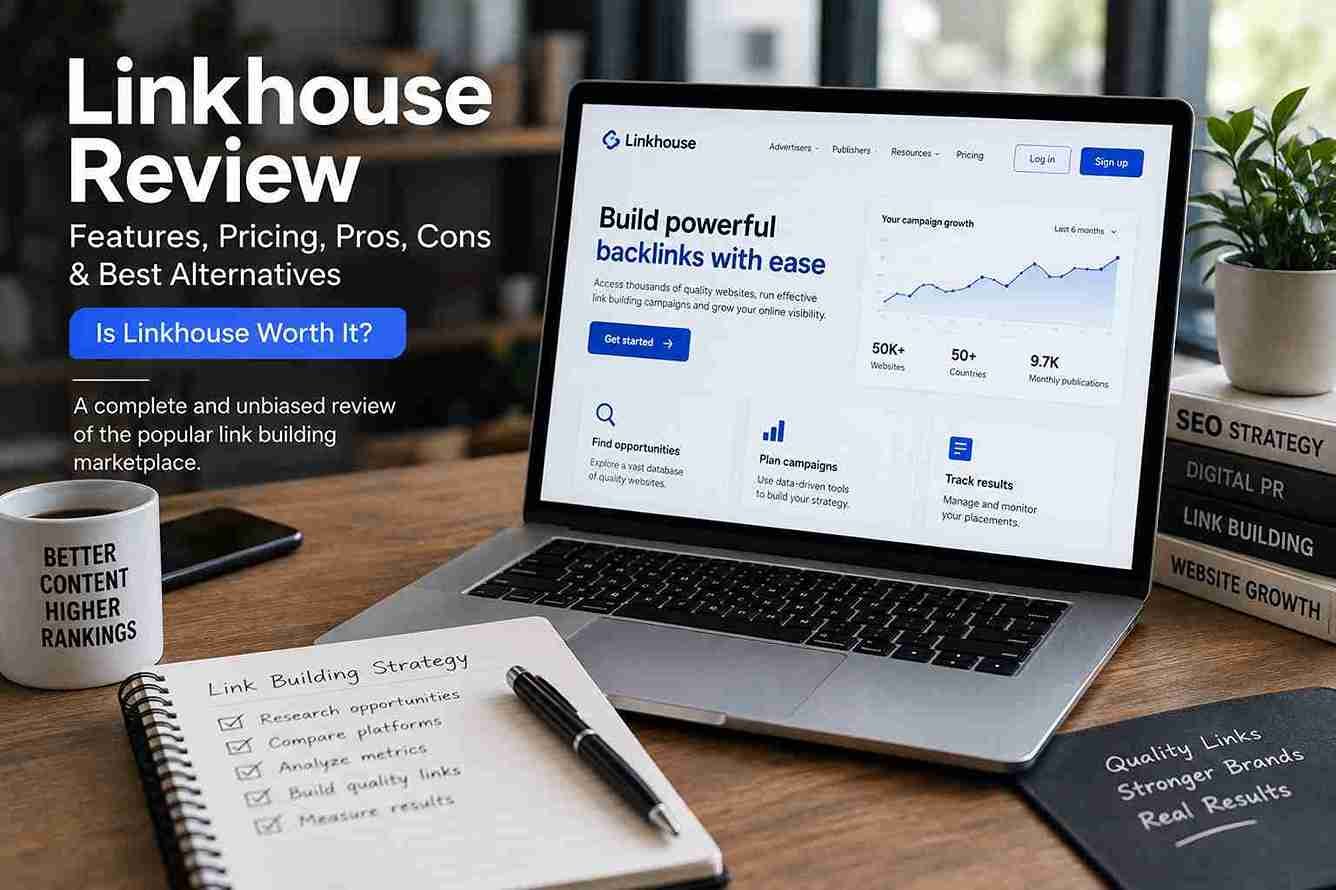
Linkhouse Review: Is This Link Building Marketplace Worth Using?
Finding high-quality websites for guest posts, sponsored articles and backlink placements is one of the most time-consuming parts of SEO.
A link builder often has to search for relevant websites, check their authority and traffic, analyze topical relevance, contact publishers, negotiate prices, arrange content and then monitor whether the publication remains live.
Doing this manually can quickly become an operational black hole.
Link building marketplaces attempt to simplify that process by bringing publishers, advertisers, SEO professionals and agencies together on one platform. Linkhouse is one of the established names in this market.
Founded in 2014, Linkhouse has developed from a sponsored-content marketplace into a broader link-building and content marketing platform. It now combines a large publisher database with campaign-planning tools, competitor backlink analysis, content placement options and monitoring features.
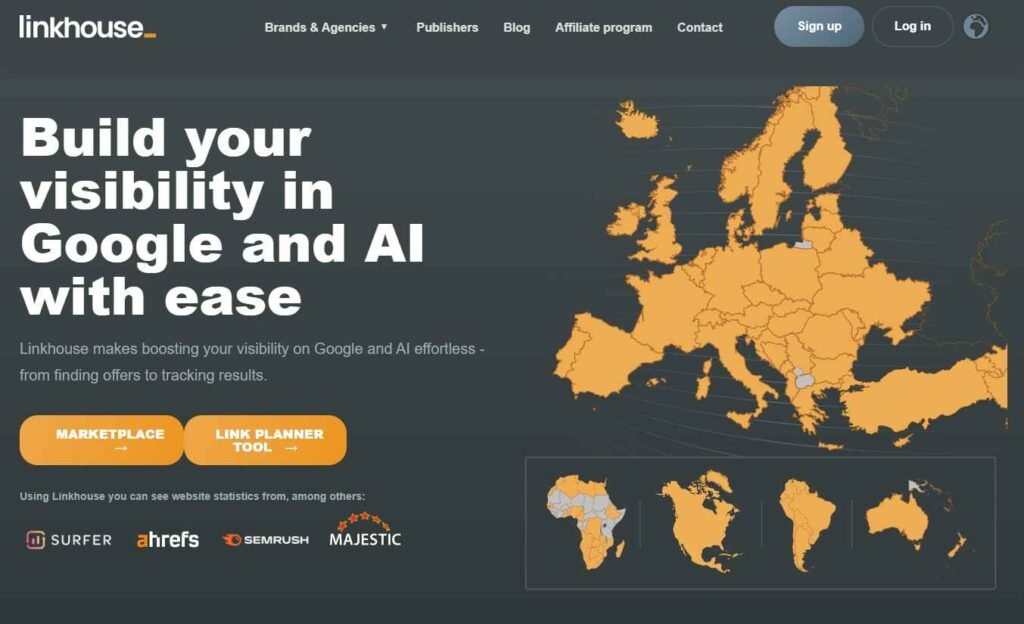
According to Linkhouse’s current platform information, its marketplace contains more than 90,000 websites, with approximately 9,700 publications processed monthly. The company positions itself as a platform for improving visibility in both traditional search engines and emerging AI discovery environments.
But the most important question remains:
Is Linkhouse actually worth using for link building?
For many agencies and businesses, the answer can be yes, particularly if they want more than a basic guest-post marketplace. Linkhouse’s biggest differentiator is its collection of tools surrounding the marketplace, especially Link Planner and Backlink Gap.
However, a large database alone does not guarantee successful SEO.
The quality of a campaign still depends on selecting relevant publishers, analysing websites carefully, creating useful content and maintaining a natural authority-building strategy.
This detailed Linkhouse review examines the platform’s features, pricing structure, advantages, disadvantages, publisher opportunities and leading competitors.
What Is Linkhouse?
Linkhouse is a content marketing and link-building marketplace connecting advertisers with publishers.
Advertisers can use the platform to discover websites and purchase promotional opportunities. Publishers can list their websites and monetize them by accepting sponsored content and other advertising formats.
The platform supports several promotional formats, including:
- Sponsored articles
- Guest posts
- Link insertions
- Advertising backlinks
- Banner advertising
- Press mentions
- Brand mentions
- Social media promotions
- Mailing promotions
This wider range of formats is one of Linkhouse’s advantages.
Many marketplaces focus almost entirely on guest posts. Linkhouse attempts to provide a broader off-site marketing environment.
For advertisers, the platform acts as a central dashboard for finding websites, evaluating metrics, planning campaigns, managing orders and monitoring placements.
For publishers, it provides access to advertisers without requiring direct outreach and negotiation with every potential client.
How Does Linkhouse Work?
The basic workflow is relatively straightforward.
An advertiser creates an account, searches the marketplace and filters available websites according to campaign requirements.
The advertiser can evaluate websites using available metrics and parameters before selecting an offer.
After selecting a website, the advertiser places an order and provides campaign instructions.
Depending on the offer, the advertiser may:
- Provide their own article
- Order content creation
- Request a link insertion
- Purchase another promotional format
The publisher receives the order and can review the requirements before publication.
Once the placement is completed, the advertiser can monitor the order through the Linkhouse dashboard.
This centralized workflow is useful for agencies handling multiple websites and campaigns.
Instead of maintaining dozens of email conversations with individual publishers, much of the campaign administration can be managed from one place.
Advanced Website Filtering
Linkhouse provides a large number of filters for searching its publisher database.
The platform states that users can access more than 60 filters to narrow down opportunities.
Filtering can help advertisers search for websites based on factors such as:
- Industry
- Category
- Country
- Language
- SEO metrics
- Traffic-related information
- Link characteristics
- Publication options
- Pricing
This is particularly valuable when managing large campaigns.
Without strong filtering, a marketplace with tens of thousands of websites can become difficult to navigate.
The objective should not be to find the website with the highest authority metric.
Instead, advertisers should use filters to identify websites that combine several positive characteristics.
These may include:
- Topical relevance
- Genuine audience
- Organic visibility
- Appropriate geographic reach
- Editorial quality
- Reasonable pricing
Link Planner: Linkhouse’s Major Differentiator
The Link Planner tool is one of the most interesting parts of the Linkhouse ecosystem.
Rather than simply helping users search for publishers, Link Planner is designed to help create a link-building campaign.
The tool can analyse a website, identify potential opportunities and suggest campaign elements such as:
- Target URLs
- Keywords
- Potential publishers
- Budget allocation
- Link-building opportunities
According to Linkhouse, the tool can generate a campaign proposal in approximately a minute.
This is particularly useful for businesses and SEO professionals who do not want to manually research every possible placement.
Users can also modify campaign recommendations before placing orders.
The key advantage is strategic workflow.
A typical marketplace begins with the question:
Which website should I buy a link from?
Link Planner attempts to begin earlier in the process by asking:
Which pages, keywords and opportunities should the campaign target?
That makes Linkhouse more than a simple publisher directory.
For agencies managing several clients, this planning layer could potentially save significant time.
Still, automated recommendations should not replace professional SEO judgment.
Users should review suggested websites and placements before purchasing them.
Automation can speed up research, but strategy still requires human evaluation.
Backlink Gap Tool
Another important Linkhouse feature is Backlink Gap.
Backlink gap analysis compares your backlink profile with competitors to identify websites linking to competing domains but not to your own website.
The idea is simple.
If several relevant competitors have links from a particular domain, that domain may represent a potential opportunity.
Linkhouse’s Backlink Gap tool allows users to:
- Enter their domain
- Select competitors
- Analyse backlink opportunities
- Review competitor linking domains
- Filter available opportunities
- Export data
- Purchase available placements through the marketplace
The tool uses data sources including Ahrefs, Semrush and Google to identify relevant competitor opportunities.
This can be particularly useful because competitor analysis and publisher discovery are often separate tasks.
Normally, an SEO professional may find a competitor backlink in one tool and then manually search for a way to contact that website.
Linkhouse attempts to connect the analysis stage with the marketplace.
This creates a smoother workflow:
Discover competitor opportunity → evaluate website → check marketplace availability → purchase placement.
That is one of the strongest practical advantages of the platform.
Linkhouse and AI Visibility
Linkhouse has also expanded its positioning toward AI visibility.
The platform now promotes its ability to help improve visibility across Google and AI environments, including systems such as ChatGPT, Perplexity, Claude and Gemini.
One of the platform’s newer approaches involves brand mentions.
Unlike a traditional backlink placement, a brand mention may promote a company without necessarily adding a hyperlink.
This reflects a broader shift in digital marketing.
Brands are increasingly interested in appearing across authoritative third-party sources because online visibility is no longer limited to ten blue links on a search results page.
However, marketers should remain realistic.
Publishing content or obtaining brand mentions does not guarantee that an AI assistant will mention your company.
AI systems use different retrieval, ranking and model processes.
The more practical takeaway is that Linkhouse provides additional formats for building third-party brand presence beyond traditional guest-post backlinks.
Linkhouse Advertising Formats
Linkhouse supports multiple advertising formats.
Sponsored Articles
Sponsored articles are one of the platform’s primary formats.
Advertisers can publish content on relevant third-party websites and potentially include brand references and links.
Sponsored articles can support:
- Brand awareness
- Referral traffic
- Content distribution
- Audience reach
- SEO strategy
The quality of the website and content is crucial.
A relevant article published on a respected industry website may be far more valuable than numerous low-quality placements.
Link Insertions
Link insertions involve adding a link to an existing article.
This can be attractive when an existing page already has topical relevance and organic visibility.
However, advertisers should review the page carefully.
A link insertion is only useful when it is editorially relevant and makes sense in the context of the existing article.
Advertising Backlinks and Banners
Publishers can also offer text links and banners.
These options can vary based on placement location and duration.
For SEO purposes, advertisers should carefully understand how paid links are implemented.
Paid or sponsored links should be handled appropriately according to search engine guidelines.
Press and Brand Mentions
Press mentions and brand mentions provide additional opportunities for businesses focused on awareness rather than only backlinks.
This can be particularly useful for companies interested in digital PR and broader off-site visibility.
Linkhouse Pricing
Linkhouse does not use a simple fixed subscription model for standard marketplace access.
Registration is free, and users can explore the platform without paying a recurring subscription fee.
The cost of a campaign depends primarily on the placements and services selected.
Prices can vary based on:
- Publisher quality
- Website traffic
- Country
- Language
- Industry
- Content requirements
- Link placement
- Promotional format
Publishers can define pricing for their offers.
Linkhouse operates using a margin model, meaning the advertiser-facing price may include the platform’s commercial margin.
This means there is no meaningful “average Linkhouse price.”
A placement on a small niche blog may cost significantly less than a sponsored article on a large media publication.
The best approach is to set a campaign budget first and then evaluate opportunities based on expected value.
Do not simply choose the cheapest links.
At the same time, do not assume that the most expensive website will automatically produce the best result.
The goal should be value per placement.
Linkhouse for Publishers
Linkhouse can also be useful for website owners and publishers.
A publisher can register for free, add websites and create offers.
The publisher can define conditions and pricing before advertisers place orders.
The publisher can also review incoming requests before accepting them.
Available monetization formats may include:
- Sponsored articles
- Link insertions
- Advertising backlinks
- Press mentions
- Brand mentions
Linkhouse also allows publishers to create promotional pricing for selected offers.
The platform states that publishers retain control over their listed prices, while Linkhouse handles the marketplace workflow, payments and advertiser access.
For publishers, the main benefit is access to potential advertisers without having to build a direct sales process.
However, publishers should maintain editorial standards.
Accepting every possible sponsored placement can eventually damage a website’s quality and reputation.
A sustainable publishing strategy should prioritize relevant collaborations.
Linkhouse Pros
- Large Marketplace: Linkhouse offers a large selection of international publishing opportunities.
- Strong SEO Tool Integration: The platform brings data from multiple SEO tools into one workflow.
- Link Planner: The AI-assisted campaign-planning system is one of Linkhouse’s strongest differentiators.
- Backlink Gap: Competitor backlink analysis integrated with placement opportunities can save substantial research time.
- Multiple Advertising Formats: The marketplace supports more than traditional guest posting.
- Free Registration: Users can create an account and explore the platform without a standard subscription fee.
- International Reach: The platform is suitable for campaigns targeting multiple countries and languages.
- Publisher Monetization: Website owners can create multiple offers and control their pricing and publication conditions.
Linkhouse Cons
- Quality Still Requires Manual Review: A large marketplace is useful, but advertisers still need to evaluate individual websites carefully.
- Placement Prices Can Vary Significantly: Premium placements may require substantial budgets.
- Automated Tools Are Not a Substitute for SEO Strategy: Link Planner and Backlink Gap can speed up work, but poor campaign objectives can still lead to poor placements.
- Large Database Can Be Overwhelming: New users may initially need time to understand filtering, campaign planning and offer selection.
- Sponsored-Link Compliance Must Be Considered: Advertisers should understand how individual publishers handle sponsored links and ensure campaigns align with applicable search engine guidelines.
Is Linkhouse Safe for SEO?
Linkhouse is a marketplace and campaign-management platform.
The SEO outcome depends on how the marketplace is used.
Buying large quantities of irrelevant placements simply because they have attractive authority metrics is not a sustainable strategy.
A better approach focuses on:
- Relevance
- Editorial quality
- Audience fit
- Natural context
- Useful content
- Reasonable link patterns
- Brand visibility
Google recommends that paid or sponsored links be appropriately qualified using attributes such as rel="sponsored".
Therefore, advertisers should always understand the conditions of each publisher offer.
A sponsored placement can still provide significant marketing value through:
- Referral traffic
- Brand awareness
- Audience discovery
- Media exposure
- Commercial credibility
The safest strategy is to view off-site placements as part of a broader marketing and authority-building program rather than as a shortcut to manipulate rankings.
Linkhouse vs Competitors
Linkhouse competes with several established platforms.
Each marketplace has its own strengths.
Linkhouse vs Collaborator
For a detailed platform analysis, read our internal Collaborator Review.
Collaborator is particularly strong for guest posting, publisher selection and direct marketplace workflows.
It provides detailed website information, audience data and advertiser reviews of publishers.
Collaborator can be a strong choice for SEO professionals who want a guest-post-focused platform with granular website selection.
Linkhouse has a stronger emphasis on additional campaign-planning tools such as Link Planner and Backlink Gap.
Choose Linkhouse if:
You want marketplace access combined with campaign planning and competitor backlink analysis.
Choose Collaborator if:
You primarily want a dedicated guest-post marketplace with detailed publisher data and direct placement management.
Linkhouse vs Adsy
For a complete comparison, read our internal Adsy Review.
Adsy focuses strongly on guest posting and digital PR.
The platform provides a large website inventory, filters based on metrics such as authority and traffic, and monitoring features.
Adsy may be particularly attractive to marketers focused primarily on finding and ordering guest posts.
Linkhouse offers a broader collection of campaign-planning tools.
Choose Linkhouse if:
You want AI-assisted campaign planning and competitor backlink discovery in addition to marketplace access.
Choose Adsy if:
Your primary objective is managing a large volume of guest-post placements through an SEO-focused marketplace.
Linkhouse vs WhitePress
Read our detailed internal WhitePress Review for a complete platform breakdown.
WhitePress is a major international content marketing and link-building marketplace.
Its biggest strengths include international coverage, multilingual content support and a large publisher network.
WhitePress can be especially attractive for businesses running campaigns across multiple countries.
Linkhouse also has international coverage but differentiates itself through tools such as Link Planner and Backlink Gap.
Choose Linkhouse if:
You want stronger built-in tools for campaign planning and competitor backlink analysis.
Choose WhitePress if:
You need extensive international content distribution and multilingual campaign support.
Linkhouse vs Getfluence
Read our detailed internal Getfluence Review for a complete analysis.
Getfluence positions itself as a broader off-site authority platform.
Its current strategy combines:
- Off-site SEO
- Sponsored media placements
- Brand authority
- AI visibility
Getfluence is particularly interesting for brands seeking premium media exposure and broader digital authority.
Linkhouse is more directly focused on link-building operations and campaign execution.
Choose Linkhouse if:
Your primary focus is efficient link-building research, competitor analysis and campaign planning.
Choose Getfluence if:
You want to combine SEO placements with premium media exposure, digital PR and AI visibility initiatives.
Linkhouse vs PRNEWS.IO
For a complete comparison, read our internal PRNEWS.IO Review.
PRNEWS.IO focuses heavily on sponsored media distribution and digital PR.
It can be useful for companies seeking wider media coverage and brand exposure.
Linkhouse is more SEO-tool-oriented.
Choose Linkhouse if:
Your campaign focuses primarily on link building and competitor-based backlink opportunities.
Choose PRNEWS.IO if:
Your primary objective is broad media coverage and digital PR distribution.
Linkhouse Competitor Comparison
| Platform | Best For | Main Strength |
|---|---|---|
| Linkhouse | SEO campaigns and link planning | Link Planner and Backlink Gap tools |
| Collaborator | Guest posts and publisher discovery | Detailed marketplace and website data |
| Adsy | Guest posting and content placement | Large inventory and placement workflow |
| WhitePress | International campaigns | Multilingual content and global reach |
| Getfluence | Authority and AI visibility | Premium media and off-site authority |
| PRNEWS.IO | Digital PR | Sponsored media distribution |
The best platform depends on your campaign.
There is no universal winner.
A small SEO agency may prefer a marketplace with fast filtering and automated planning.
A multinational company may prioritize international media coverage.
A brand-focused business may prefer digital PR opportunities.
The right choice depends on the objective.
Who Should Use Linkhouse?
Linkhouse can be particularly useful for:
SEO Agencies
Agencies managing multiple client campaigns can benefit from the centralized dashboard and campaign tools.
Link Builders
Backlink Gap and marketplace filtering can reduce manual research.
Businesses
Companies can use Linkhouse to build awareness and discover relevant third-party publishing opportunities.
International Marketers
The marketplace provides access to websites across multiple markets.
Publishers
Website owners can monetize sponsored content opportunities while maintaining control over publication approval.
Final Verdict: Is Linkhouse Worth It?
Linkhouse is more than a basic guest-post marketplace.
Its publisher database is certainly one of its biggest assets, but the platform’s real differentiation comes from the tools built around the marketplace.
Link Planner helps users move from campaign objective to placement recommendations.
Backlink Gap connects competitor analysis with publisher opportunities.
Multiple advertising formats allow users to go beyond traditional guest posts.
For agencies and active SEO professionals, these features can make Linkhouse an efficient operational platform.
However, the platform should not be treated as an automatic SEO solution.
A large publisher database does not remove the need for strategy.
The best results will come from selecting relevant websites, publishing useful content and evaluating placements based on real business objectives.
If your priority is finding the cheapest possible backlinks, Linkhouse may not always be the best option.
If you want a broader link-building platform that combines marketplace access, SEO metrics, competitor analysis and campaign planning, Linkhouse is one of the stronger options currently available.
Our verdict: Linkhouse is particularly valuable for SEO agencies, link builders and businesses that want to move from manual backlink research toward a more centralized and data-supported campaign workflow.
The current Linkhouse review above is based primarily on Linkhouse’s official marketplace and product documentation. Linkhouse currently promotes more than 90,000 websites, around 9,700 monthly publications, international marketplace coverage, and visibility support across traditional search and AI environments.
Its current advertiser offering includes sponsored articles, link insertions, banners, social media and mailing promotions, while the marketplace provides free registration and centralized project and order management.
The Link Planner and Backlink Gap sections are based on Linkhouse’s current product pages describing AI-assisted campaign planning, competitor backlink discovery, integrations with SEO data sources, budget allocation and direct purchase workflows.
The pricing discussion reflects Linkhouse’s current free-registration model and margin-based publisher marketplace terms. Individual placement prices vary by publisher and offer.
The discussion of sponsored-link compliance follows Google’s current guidance that advertisements and paid placements should generally be qualified with rel="sponsored", with nofollow also accepted in relevant circumstances.
Frequently Asked Questions About Linkhouse
| What is Linkhouse? |
|---|
| Linkhouse is a link-building and content marketing marketplace that connects advertisers with publishers. Advertisers can purchase sponsored articles, guest posts, link insertions, banners, brand mentions and other promotional formats. |
| Is Linkhouse free to use? |
| Linkhouse allows users to register and use many of its platform features without a standard subscription fee. Advertisers generally pay for the individual placements and services they purchase. |
| How many websites are available on Linkhouse? |
| Linkhouse currently states that its marketplace contains more than 90,000 websites. The available publisher database and offers can change as websites are added, removed or updated. |
| What is Link Planner? |
| Link Planner is Linkhouse’s campaign-planning tool designed to analyse websites and help users prepare link-building campaigns. It can suggest target opportunities, URLs, keywords and publishers based on campaign requirements and available budget. |
| What is the Linkhouse Backlink Gap tool? |
| Backlink Gap is a competitor backlink analysis tool. It helps users identify websites that link to competing domains but do not currently link to their own website, allowing them to investigate potential link-building opportunities. |
| Can I buy guest posts on Linkhouse? |
| Yes. Sponsored articles and guest-post-style content placements are among the main advertising formats available through Linkhouse. Availability and pricing depend on individual publishers. |
| Does Linkhouse offer link insertions? |
| Yes. Linkhouse supports link insertion opportunities where advertisers can request a relevant link to be added to existing published content, subject to the publisher’s offer and approval. |
| How does Linkhouse pricing work? |
| Linkhouse does not have one universal price for placements. Registration is free, while individual publishers and offers have different costs. Pricing depends on the website, market, metrics, content requirements and promotional format. |
| Can publishers make money with Linkhouse? |
| Yes. Publishers can register, add websites and create advertising offers. They can monetize sponsored articles, link insertions, advertising links, press mentions and other available formats. |
| Is Linkhouse good for SEO agencies? |
| Linkhouse can be particularly useful for SEO agencies because it combines a publisher marketplace with campaign planning, competitor backlink analysis, filtering tools and centralized order management. |
| How does Linkhouse compare with Collaborator? |
| Linkhouse provides additional campaign-planning and competitor backlink tools, while Collaborator is particularly strong for guest-post campaigns, publisher discovery, detailed website data and advertiser reviews. |
| How does Linkhouse compare with Adsy? |
| Both platforms provide guest-post and content-placement opportunities. Linkhouse differentiates itself with tools such as Link Planner and Backlink Gap, while Adsy is strongly focused on guest posting and large-scale content placement. |
| How does Linkhouse compare with WhitePress? |
| Linkhouse focuses strongly on link-building workflow and campaign tools, while WhitePress is especially well known for international content distribution, multilingual campaigns and global publisher reach. |
| How does Linkhouse compare with Getfluence? |
| Linkhouse is more focused on link-building operations and SEO campaign tools. Getfluence has a broader positioning around off-site authority, premium media coverage, digital PR and AI visibility. |
| Is Linkhouse safe for link building? |
| The platform itself provides marketplace and campaign-management tools, but the quality and compliance of an SEO campaign depend on how placements are selected and implemented. Advertisers should prioritize relevance, editorial quality and appropriate handling of sponsored links. |
| Is Linkhouse worth using? |
| Linkhouse can be worth using for SEO agencies, link builders, businesses and publishers looking for a large marketplace combined with campaign-planning tools, backlink gap analysis and centralized placement management. |