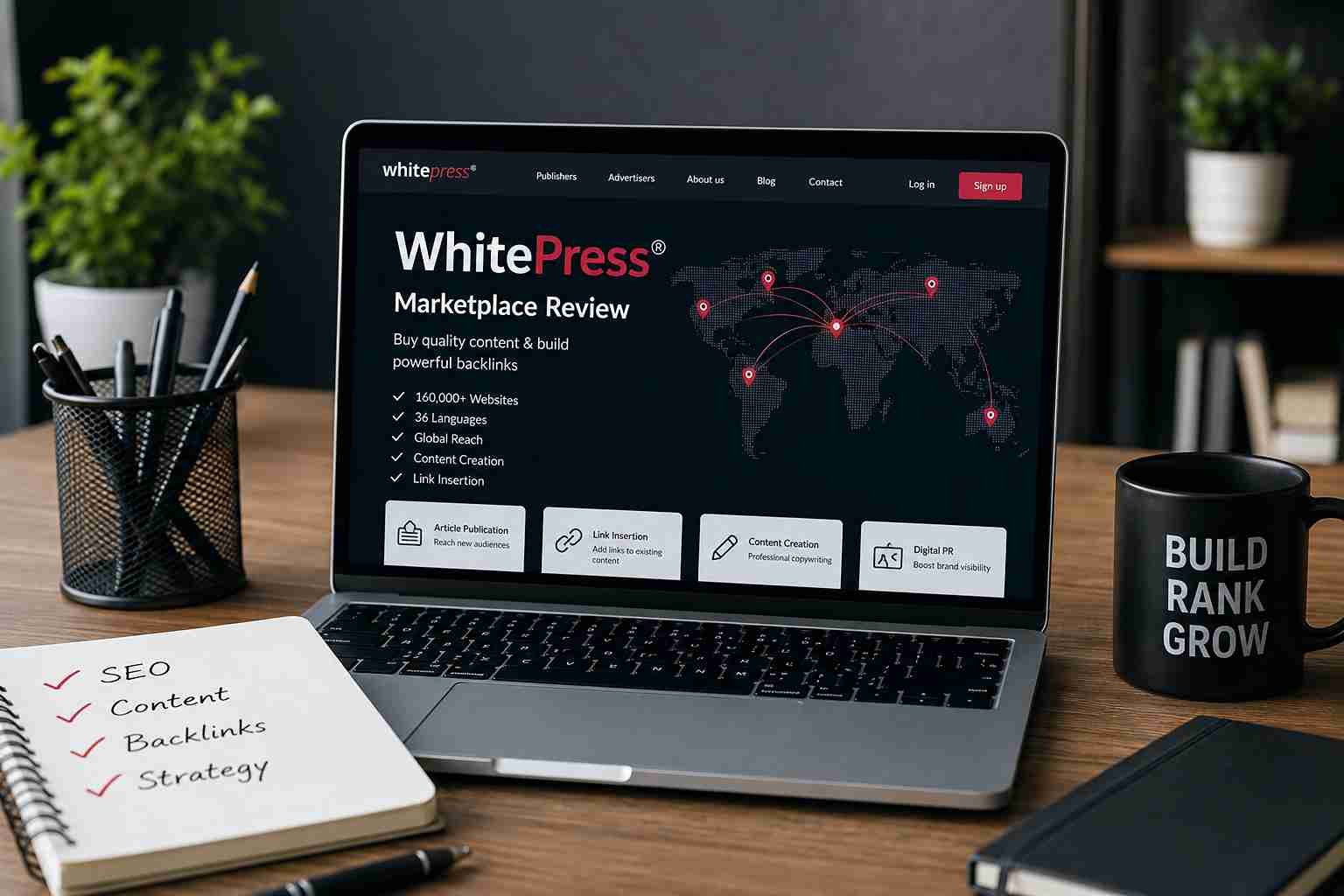
WhitePress Marketplace Review: Features, Pricing, Pros, Cons and Alternatives
Finding relevant websites for guest posting, sponsored content, digital PR, and link building can be one of the most time-consuming parts of an SEO campaign.
Traditional outreach requires marketers to identify suitable websites, find contact information, negotiate prices, discuss content requirements, arrange payments, follow up with publishers, and verify whether the agreed publication has actually gone live. This process can become particularly complex when a business is running campaigns across multiple countries and languages.
Link building marketplaces attempt to simplify this process by bringing publishers and advertisers together on a single platform.
WhitePress is one of the established platforms operating in this space. It connects advertisers, SEO professionals, agencies, and brands with website publishers offering sponsored content, article publication, link insertion, and other promotional opportunities.
However, the real question is not simply whether WhitePress has a large publisher database.
The more important questions are:
- Is WhitePress suitable for your SEO strategy?
- How does the marketplace work?
- What types of publications and placements can you order?
- Is it useful for international link building?
- What are its advantages and limitations?
- How should advertisers evaluate websites before placing an order?
This detailed WhitePress marketplace review examines the platform from the perspective of advertisers, SEO professionals, agencies, brands, and publishers.
Quick Verdict: WhitePress is a strong option for businesses and agencies looking for a centralized marketplace for international content placement, sponsored articles, link building, digital PR, and publisher discovery. Its major strengths are its broad international coverage, extensive publisher database, advanced filtering, content ordering options, and campaign management features. However, advertisers should still evaluate individual publishers carefully because the quality and SEO value of a placement depend on the specific website selected rather than the marketplace alone.
What Is WhitePress?
WhitePress is a global content marketing and link building marketplace that connects advertisers with website publishers.
Advertisers can use the platform to discover websites where they may be able to publish sponsored articles, expert content, promotional material, and other forms of content-based placements.
Publishers, on the other hand, can add their websites to the marketplace and receive opportunities from advertisers and agencies.
The platform is designed to reduce many of the administrative challenges associated with direct publisher outreach.
Instead of negotiating separately with hundreds of website owners, advertisers can search for available publishers, review offer details, compare relevant metrics, select opportunities, order content when needed, and manage publication campaigns through one platform.
WhitePress has gradually expanded beyond the traditional guest-posting marketplace model.
Today, its ecosystem includes services and opportunities related to:
- Sponsored article publication
- Content distribution
- Link building
- Link insertion
- Digital PR
- Copywriting
- Brand mentions
- Banner advertising opportunities
- Publisher monetization
- Backlink monitoring and management
- International outreach
This broader approach makes WhitePress relevant not only for businesses attempting to acquire backlinks but also for brands seeking wider online visibility.
The marketplace can therefore support different campaign objectives.
One advertiser may want a relevant editorial backlink.
Another may want brand exposure on an established publication.
A third may be interested in entering a foreign market.
An agency may need to manage multiple client campaigns.
WhitePress is designed to provide a marketplace environment where these requirements can be managed through publisher offers and campaign tools.
How Does WhitePress Work?
The basic WhitePress workflow is relatively straightforward.
An advertiser creates an account and sets up a project representing the website, brand, product, or campaign they want to promote.
The advertiser can then search the available publisher database and filter websites based on campaign requirements.
Once suitable websites have been identified, the advertiser can review the available offer and select a publication opportunity.
Depending on the campaign, the advertiser may provide their own content or use content creation services.
After selecting an offer and completing the required order process, the publisher receives the request and the campaign progresses through publication and verification stages.
This centralized workflow is one of the platform’s major advantages.
Without a marketplace, an international outreach campaign could require communication with dozens of different publishers.
Each publisher may have different:
- Pricing structures
- Publication rules
- Content requirements
- Link policies
- Payment methods
- Languages
- Publication timelines
A marketplace does not eliminate the need for due diligence, but it can reduce administrative friction.
WhitePress for Advertisers
For advertisers, the core purpose of WhitePress is to simplify the process of finding and purchasing content publication opportunities.
The platform can be particularly useful for:
- SEO agencies
- In-house SEO teams
- Digital marketing agencies
- Link building specialists
- Content marketing teams
- E-commerce businesses
- International brands
- Website owners
The advertiser experience generally begins with creating a project.
A project helps organize campaign activity around a specific website or promotion objective.
For example, an agency managing five different clients can maintain separate projects rather than mixing all orders into one campaign environment.
This becomes especially useful when campaigns involve different:
- Target URLs
- Languages
- Countries
- Industries
- Budgets
- Content strategies
After creating a project, advertisers can search for relevant publisher opportunities.
The marketplace approach provides a significant advantage here because advertisers can compare multiple options before deciding where to publish.
Finding Publishers Through the WhitePress Marketplace
A major feature of WhitePress is its publisher search and filtering system.
When selecting websites for a campaign, marketers rarely want to browse an enormous unorganized database.
A business promoting a financial product, for example, may not want placements on unrelated entertainment or lifestyle websites.
Similarly, an e-commerce brand targeting a specific country may need publishers serving that particular market.
Filtering helps narrow the selection.
WhitePress provides a range of parameters intended to help advertisers identify websites that match campaign requirements.
Depending on the available data and market, advertisers can evaluate factors such as:
- Website topic
- Country or market
- Language
- Price
- Traffic-related data
- SEO metrics
- Link characteristics
- Publication requirements
- Content type
- Available promotional opportunities
This is important because a good link building campaign should not select websites based solely on a single authority metric.
A high Domain Rating does not automatically mean that a website is relevant to your audience.
Likewise, a cheap placement is not automatically a good investment.
The best publisher for a campaign depends on the objective.
For an SEO-focused campaign, topical relevance and the quality of the publishing website may be central considerations.
For a digital PR campaign, audience reach and publication reputation may be more important.
For an international expansion campaign, local language relevance and country-specific visibility may become essential.
WhitePress provides the discovery environment, but the final decision still belongs to the advertiser.
Sponsored Article Publication
Sponsored and paid article publication is one of the core use cases of WhitePress.
The advertiser selects a publisher website and arranges for an article to be published.
The content may include:
- A brand mention
- A company introduction
- Product information
- A contextual backlink
- Expert commentary
- Educational information
- Promotional content
The exact rules depend on the publisher’s offer.
This is an important distinction.
WhitePress is a marketplace, not a guarantee that every publisher will provide identical terms. One website may allow a particular link type. Another may have specific content restrictions. Another may require a certain article length. Another may focus primarily on editorial or branded content.
For this reason, advertisers should always review the individual offer before placing an order.
The best approach is to define campaign requirements before searching.
For example:
- SEO objective: Find thematically relevant publications where a contextual placement can support broader organic visibility goals.
- Brand awareness objective: Prioritize publishers with an audience relevant to the brand and a strong editorial environment.
- International objective: Focus on publications in the target country and language.
Defining the objective first prevents the common mistake of choosing placements simply because a website appears to have attractive SEO metrics.
Content Creation and Copywriting Services
Content production can become a bottleneck in large-scale outreach campaigns.
Even after finding the right publisher, an advertiser still needs an article that satisfies both the publisher’s editorial requirements and the campaign’s marketing objectives.
WhitePress provides content ordering options that can help advertisers who do not already have articles prepared.
This can be particularly useful for international campaigns.
Imagine a company based in India attempting to build visibility in Poland, Germany, Spain, France, or another international market.
Producing genuinely natural content in multiple languages can be difficult.
Literal translation may not be sufficient.
Content often needs to account for:
- Local language conventions
- Market terminology
- Cultural context
- Industry vocabulary
- Search behavior
- Publisher requirements
Using local-language content resources can therefore be valuable for international publication campaigns.
However, advertisers should still review content carefully before publication.
Outsourced content should not be treated as a completely hands-off process.
The advertiser remains responsible for ensuring that the article accurately represents the brand and provides useful information.
Link Insertion Opportunities
WhitePress also offers opportunities beyond publishing completely new articles.
Link insertion allows advertisers to explore the possibility of placing links within existing content or other publisher-defined locations.
This can be attractive because an established article may already have:
- Search visibility
- Existing traffic
- Topical relevance
- Internal links
- Historical indexing
However, advertisers should evaluate link insertion opportunities carefully.
The key question should not simply be:
Can I get a link on this website?
A better question is:
Does the existing page make contextual sense for my website or target URL?
A link inserted into an unrelated article may have limited marketing value.
For example, adding a web hosting link to an article about digital marketing may be contextually reasonable.
Adding the same link to an unrelated celebrity article may be much harder to justify from a relevance perspective.
The strongest link placements generally fit naturally within the subject matter of the surrounding content.
Advertisers should therefore examine:
- The article topic
- Existing content quality
- Organic visibility of the page
- Context surrounding the potential placement
- Relevance to the target page
- Publisher linking policies
Marketplace convenience should never replace editorial judgment.
International Link Building with WhitePress
International reach is one of WhitePress’s most important advantages.
Managing publisher relationships in one country can already be challenging.
Managing them across multiple countries introduces additional complications.
These may include:
- Language barriers
- Different pricing expectations
- Local publisher networks
- Different content requirements
- Local SEO practices
- Currency and payment processes
WhitePress attempts to centralize access to publishers across multiple markets.
This can be particularly useful for businesses that are expanding internationally.
For example, a software company might have separate SEO strategies for:
- The United Kingdom
- Germany
- Spain
- Italy
- Poland
- The United States
Each market may require locally relevant content and placements.
A link profile built exclusively from one country may not provide the same strategic relevance as a campaign that includes publications in the markets where the company actually operates.
WhitePress can simplify the discovery and management side of such campaigns.
However, international campaigns still require local strategy.
A successful English-language content strategy cannot simply be translated and expected to perform identically in every market.
The publisher selection, content angle, keyword strategy, and audience expectations should all be considered.
WhitePress Analytics and Website Evaluation
One of the biggest challenges in using any link building marketplace is evaluating quality.
A large database is useful only if advertisers can identify appropriate opportunities.
WhitePress provides website data and scoring tools intended to help users compare publishers.
The platform also incorporates information from well-known SEO data providers and its own evaluation systems.
This can help advertisers review multiple factors before making a decision.
However, no automated metric should be treated as the complete answer.
A good publisher evaluation process should include a manual review.
Before purchasing a placement, consider checking:
Website Relevance
Does the website publish content related to your industry?
A backlink from a relevant publication can be easier to justify strategically than a link from an unrelated website.
Content Quality
Are the existing articles useful and well-written?
Or does the website appear to publish large volumes of low-quality sponsored content?
Organic Visibility
Does the website appear to receive meaningful search visibility?
SEO metrics alone can sometimes paint an incomplete picture.
Audience Alignment
Would the readers of this website realistically be interested in your brand, product, or content?
Sponsored Content Volume
A website publishing an extremely high proportion of promotional articles may deserve additional scrutiny.
Editorial Standards
Does the publisher appear to have reasonable standards for what it publishes?
These questions remain important regardless of which marketplace you use.
Traffic Guarantees and Campaign Visibility
Some publication opportunities may include traffic-related features or guarantees depending on the publisher offer and campaign type.
For advertisers focused on brand exposure rather than only backlink acquisition, this can be useful.
A publication can create value in multiple ways.
It may:
- Generate referral traffic
- Improve brand awareness
- Reach a new audience
- Support content distribution
- Create search visibility
- Generate secondary mentions
This broader perspective is important.
Link building is increasingly connected with brand visibility and digital PR.
A high-quality publication may provide value even if the immediate SEO impact is difficult to isolate.
For this reason, advertisers should avoid measuring every placement exclusively by whether a keyword moves up or down after publication.
SEO outcomes are influenced by many variables.
A broader campaign measurement framework is often more useful.
WhitePress for Publishers
WhitePress is not only designed for advertisers.
Website owners and publishers can also use the marketplace to monetize their publishing inventory.
A publisher can add a website and create offers based on the types of placements they are willing to provide.
Depending on the available options, this can include content publication and other promotional formats.
The marketplace can help publishers access advertisers without needing to build an internal sales team for every campaign.
This can be particularly useful for:
- Bloggers
- Niche publishers
- Online magazines
- Regional publications
- Industry websites
- News portals
- Content websites
Publishers can potentially use the platform as an additional revenue channel.
However, publishers should also think carefully about editorial standards.
Accepting every available sponsored article may create short-term revenue but could damage the quality and credibility of the website.
A sustainable publisher strategy should define:
- Accepted industries
- Prohibited topics
- Content quality requirements
- Link policies
- Disclosure practices
- Pricing standards
WhitePress for Publishers
WhitePress is not only designed for advertisers.
Website owners and publishers can also use the marketplace to monetize their publishing inventory.
A publisher can add a website and create offers based on the types of placements they are willing to provide.
Depending on the available options, this can include content publication and other promotional formats.
The marketplace can help publishers access advertisers without needing to build an internal sales team for every campaign.
This can be particularly useful for:
- Bloggers
- Niche publishers
- Online magazines
- Regional publications
- Industry websites
- News portals
- Content websites
Publishers can potentially use the platform as an additional revenue channel.
However, publishers should also think carefully about editorial standards.
Accepting every available sponsored article may create short-term revenue but could damage the quality and credibility of the website.
A sustainable publisher strategy should define:
- Accepted industries
- Prohibited topics
- Content quality requirements
- Link policies
- Disclosure practices
- Pricing standards
The strongest publishing businesses treat sponsored content as part of a broader commercial strategy rather than allowing paid placements to overwhelm their editorial identity.The strongest publishing businesses treat sponsored content as part of a broader commercial strategy rather than allowing paid placements to overwhelm their editorial identity.
WhitePress Pricing: How Much Does It Cost?
WhitePress does not operate like a simple subscription service with one fixed publication price for every website.
Pricing generally depends on the individual publisher and offer selected.
This means campaign costs can vary significantly.
Factors influencing the cost of a placement may include:
- Publisher authority
- Organic traffic
- Audience size
- Country
- Industry
- Website reputation
- Content requirements
- Link attributes
- Publication format
- Additional promotional features
An advertiser may find relatively affordable niche websites alongside significantly more expensive established media publications.
This flexibility is useful because campaigns can be built around different budgets.
However, it also means that advertisers need to establish their own pricing standards.
A high price does not automatically mean high quality.
Likewise, a low-cost placement is not automatically poor.
The value of an opportunity should be evaluated against campaign objectives.
For example, a highly targeted industry website with a modest audience may be more valuable to a B2B company than a broad general-interest publication.
The goal should be to evaluate cost versus strategic value, rather than simply searching for the cheapest backlink or the highest authority metric.
Pros of WhitePress
- Strong International Reach: WhitePress is particularly useful for marketers running campaigns across multiple countries and languages. Managing international publishers through a centralized marketplace can save substantial time.
- Large Range of Publisher Opportunities: A broad marketplace gives advertisers more opportunities to compare publishers across industries, markets, and price ranges.
- Advanced Publisher Discovery: Filtering and website comparison features can make it easier to narrow a large database into a more relevant shortlist.
- Multiple Campaign Formats: The platform supports more than basic sponsored article publication. Its broader ecosystem includes opportunities connected with content distribution, link insertion, digital PR, brand visibility, and publisher monetization.
- Content Ordering Options: Advertisers without ready-made content can access content creation options, which may be particularly useful for multilingual campaigns.
- Useful for Agencies: Agencies managing multiple websites and clients can organize campaigns through separate projects and centralized workflows.
- Transparency Before Ordering: The marketplace structure allows advertisers to review offer details and compare opportunities before deciding where to spend their budget.
Cons of WhitePress
- Publisher Quality Can Vary: A marketplace can provide access to many websites, but individual quality varies. Advertisers must evaluate each opportunity independently.
- Metrics Should Not Replace Manual Analysis: SEO metrics are useful screening tools, but they should not be the only reason for purchasing a placement.
- International Campaigns Still Require Local Knowledge: Access to publishers does not automatically create an effective international SEO strategy. Content and publisher selection should still reflect local markets.
- Large Databases Can Feel Overwhelming: A broad selection creates choice, but inexperienced users may initially find it difficult to identify the best opportunities.
- Pricing Varies Considerably: Because publishers set different prices, advertisers need a clear budget and evaluation framework.
WhitePress Review: Our Verdict So Far
WhitePress is best viewed as a campaign marketplace and publisher discovery platform rather than a shortcut to guaranteed SEO success.
Its value comes from reducing the operational complexity of content distribution and publisher outreach.
For agencies, international brands, and experienced SEO teams, this can be a significant advantage.
The platform is especially worth considering if your campaign requires:
- International publisher access
- Multilingual content distribution
- Sponsored articles
- Link insertion opportunities
- Digital PR placements
- Centralized campaign management
At the same time, the platform should be used strategically.
Do not select publishers based only on Domain Rating.
Do not purchase placements simply because they are inexpensive.
Do not assume every backlink will have the same value.
And do not treat marketplace availability as a replacement for proper SEO judgment.
The best results are likely to come from campaigns that combine WhitePress’s discovery and management tools with careful publisher selection, relevant content, and a long-term visibility strategy.
WhitePress Features Explained in Detail
WhitePress has developed beyond a basic guest posting marketplace. Its current platform is positioned around content distribution, link building, digital PR, publisher relationships, and broader online visibility.
Understanding the available features is important because different campaigns may require completely different approaches.
A business looking for brand awareness, for example, should not evaluate publisher opportunities in exactly the same way as an SEO team looking for relevant editorial placements.
The main features available through the WhitePress ecosystem include article publication, publisher discovery, copywriting, link insertion, campaign management, international content distribution, and publisher monetization.
Article Publication
Article publication remains one of the central functions of WhitePress.
Advertisers can search for publishers and arrange for promotional, expert, sponsored, or content-based articles to be published on relevant websites.
The process is generally built around four stages:
- Preparing or ordering content
- Selecting suitable publishers
- Placing and managing the order
- Monitoring the publication and campaign
This structure can be significantly more efficient than managing separate email conversations with dozens of publishers.
For each campaign, advertisers should clearly define the purpose of the article.
An article can be created primarily for:
- Search visibility
- Brand awareness
- Referral traffic
- Digital PR
- Product education
- International market expansion
- Thought leadership
The purpose should influence both the publisher selection and the content itself.
For example, an SEO-focused article may prioritize topical relevance and contextual placement. A digital PR campaign may place greater importance on audience reach, editorial reputation, and brand exposure.
The strongest campaigns understand that these objectives can overlap, but they should not be confused.
Website Search and Publisher Filters
One of the biggest practical advantages of a large marketplace is the ability to compare multiple publishers in one place.
WhitePress provides a search environment where advertisers can narrow publisher opportunities according to campaign requirements.
Depending on the available market and publisher data, advertisers can assess factors such as:
- Language
- Country
- Website category
- Price
- SEO-related metrics
- Traffic-related information
- Link options
- Publication conditions
- Publisher requirements
This can save a substantial amount of time.
However, filters should be used to create a shortlist, not to make the final decision automatically.
A common mistake in link building is filtering websites by a minimum authority score and purchasing the first available placements.
That approach can produce a link profile that looks impressive inside a spreadsheet but provides limited strategic value.
Instead, advertisers should use marketplace filters as the first stage of research.
The second stage should involve manual evaluation.
Visit the website.
Read its content.
Review the type of articles it publishes.
Check whether the website has a genuine topical relationship with your industry.
Examine whether readers would realistically find your content or product relevant.
The best link building decisions usually happen when automated data and human judgment work together.
WhitePress Link Insertion
Link insertion is one of WhitePress’s notable features.
Instead of creating and publishing an entirely new article, advertisers may have opportunities to place a link within existing content or other publisher-defined areas.
This can be appealing because an existing page may already have a publishing history.
It may also already be indexed and potentially have:
- Existing search visibility
- Historical traffic
- Internal links
- Relevant content
- An established URL
WhitePress currently describes link insertion opportunities across existing editorial content, dedicated sections and, where offered, site-wide placements. The platform’s current link insertion section also promotes access to more than 160,000 offers and support across 36 languages.
However, advertisers should approach link insertion with the same level of scrutiny as article publication.
The placement must make contextual sense.
A backlink should not feel like a foreign object dropped into an article from another planet.
If a reader encounters the link, there should be a logical reason for it to be there.
Before ordering a link insertion, consider:
Is the Existing Article Relevant?
The surrounding article should have a meaningful relationship with your target page.
Does the Page Have Real Value?
An indexed page is not automatically a valuable page.
Review its quality, topic, structure, and overall usefulness.
Is the Placement Natural?
The link should fit naturally within the surrounding paragraph.
Does the Publisher Have a Genuine Audience?
Where possible, consider whether the website attracts relevant readers rather than focusing only on third-party metrics.
Link insertion can be a useful way to diversify an outreach campaign, but relevance should remain the north star.
Copywriting and Content Services
Content creation is often one of the most difficult parts of international link building.
Finding publishers is only half the job.
The content must also meet editorial requirements while supporting the advertiser’s communication objectives.
WhitePress provides copywriting and content ordering options that can help advertisers create articles for publication.
This is particularly useful for campaigns involving multiple countries and languages.
A company expanding internationally may need content adapted for local audiences rather than simply translated word for word.
For example, terminology used in the United Kingdom may differ from terminology preferred in the United States.
The same challenge becomes even more significant when publishing across non-English-speaking markets.
A quality international content strategy should consider:
- Native language usage
- Local terminology
- Cultural context
- Industry-specific language
- Audience expectations
- Publisher guidelines
Advertisers should nevertheless review every piece of commissioned content.
Even high-quality outsourced content requires strategic oversight.
The brand should ensure that the article is accurate, relevant, and aligned with its long-term reputation.
Digital PR and Brand Visibility
Modern link building is increasingly connected with digital PR.
A high-quality publication can create value beyond the backlink itself.
It may introduce a brand to a new audience, generate referral visits, create secondary mentions, and strengthen the brand’s association with a particular topic.
WhitePress has increasingly positioned its platform around visibility across traditional search and emerging AI-driven discovery environments, alongside its established SEO, link building and digital PR services.
For this reason, marketers using WhitePress should think beyond a simple question such as:
How many links will this campaign generate?
A more useful question may be:
How many meaningful visibility opportunities will this campaign create?
This perspective changes publisher selection.
A website with a highly relevant audience may be valuable even if its traditional SEO metrics are not the highest available.
Similarly, an established publication may provide brand and referral value that cannot be measured solely through a backlink metric.
The best campaigns increasingly combine:
- SEO value
- Topical relevance
- Brand visibility
- Audience relevance
- Referral potential
- Editorial credibility
Brand Mentions and Additional Advertising Formats
WhitePress has also expanded advertising opportunities beyond traditional article publication and backlinks.
Its platform has introduced additional publisher formats, including brand mentions and banner advertising options.
Brand mentions can support campaigns where the objective is broader awareness rather than obtaining a hyperlink.
Banner opportunities can provide another route for advertisers interested in visibility and potential traffic.
For publishers, these additional formats can create more monetization opportunities.
This expansion reflects a broader change in digital marketing.
Businesses are increasingly interested in being visible across multiple channels rather than relying entirely on one type of placement.
For advertisers, this means a marketplace campaign can potentially include different forms of exposure depending on the objectives.
However, each format should be measured differently.
A contextual editorial placement and a display banner do not serve exactly the same purpose.
Campaign success should therefore be connected to the original objective.
WhitePress Backlink Management
Managing a large number of placements can become difficult.
This is particularly true for agencies handling multiple clients or businesses running international campaigns.
After publications go live, marketers may need to monitor:
- Publication status
- Target URLs
- Link placement
- Link attributes
- Content URLs
- Campaign history
- Publisher details
Centralized campaign management can make this process more organized than tracking every placement manually through spreadsheets and email threads.
However, businesses should maintain their own campaign records as well.
A good link building operation should know:
- Which URLs are being promoted
- Why each publisher was selected
- Which campaign created each placement
- What type of placement was purchased
- How the placement contributes to the broader strategy
Without documentation, link building can quickly become a collection of disconnected transactions.
A marketplace is most valuable when it becomes part of a structured campaign process.
How to Choose the Right Publishers on WhitePress
The marketplace may provide a large number of options, but more options do not automatically make the decision easier.
The following approach can help advertisers build a more strategic shortlist.
Start With Topical Relevance
Look for websites related to your industry, product, or target audience.
Perfect relevance is not always possible, especially in narrow niches, but there should be a logical connection.
For example:
A cybersecurity company may consider technology, business, enterprise IT, software, and security publications.
A travel company may consider travel, tourism, lifestyle, regional, and destination-focused websites.
The context matters.
Review the Website Manually
Do not rely exclusively on platform metrics.
Open the website and examine it as a real visitor would.
Ask:
- Is the website professionally maintained?
- Are articles useful?
- Is the content regularly updated?
- Does the publication have a recognizable editorial identity?
- Are sponsored articles overwhelming the website?
Manual review often reveals information that a metric cannot.
Check the Publisher’s Audience
Where audience information is available, consider whether the website reaches people relevant to your business.
A niche audience can sometimes be more valuable than a much larger general audience.
Evaluate the Cost Against the Objective
Do not ask whether a placement is cheap.
Ask whether it is valuable for the campaign.
A relatively expensive placement may make sense if it reaches an important audience.
A cheap placement may be wasted money if it has little relevance.
Diversify Your Publisher Profile
Avoid building every placement from the same type of website.
A more natural strategy may involve different:
- Website sizes
- Publication types
- Markets
- Topics
- Content formats
Diversification should be strategic rather than random.
A Practical WhitePress Campaign Workflow
For advertisers new to the marketplace, the following process can provide a useful framework.
Step One: Define the Campaign Objective
Decide what you want to achieve.
Possible objectives include:
- Supporting organic visibility
- Reaching a new market
- Increasing brand awareness
- Promoting a specific product
- Generating referral traffic
- Supporting digital PR
Avoid mixing objectives without priorities.
Step Two: Select the Target Pages
Identify the pages that deserve promotion.
These could include:
- Important commercial pages
- Product pages
- Category pages
- Research resources
- High-quality informational content
The target page should be genuinely useful.
Promoting weak pages through paid placements is rarely a sustainable strategy.
Step Three: Build a Publisher Shortlist
Use WhitePress filters to identify possible websites.
Then manually evaluate the most promising opportunities.
Step Four: Choose or Create the Content
Prepare content that genuinely fits the publication.
Avoid forcing exact-match anchor text into every article.
The content should read naturally and provide value independently of the link.
Step Five: Review Publication Requirements
Every publisher may have different rules.
Check the offer carefully before ordering.
Step Six: Place and Monitor the Order
Track the publication process and confirm that the final result matches the agreed requirements.
Step Seven: Measure the Campaign
Monitor results using a broader set of metrics.
Depending on your objective, these may include:
- Organic visibility
- Referral traffic
- Brand searches
- Conversions
- Publisher engagement
- New rankings
- Audience exposure
SEO is rarely a one-link, one-ranking equation.
Campaigns should be measured over time.
WhitePress Alternatives
WhitePress is a strong marketplace, but it is not the only option.
Different platforms may be better suited to different campaign requirements.
Collaborator
Collaborator Marketplace is a platform connecting advertisers and publishers for content publication and link-building opportunities. It can be worth considering for marketers who want a marketplace-focused workflow and access to publishers across different markets.
Read our detailed Collaborator Marketplace Review for features, pricing, advantages, and limitations.
Adsy
Adsy is another marketplace used for sponsored content and guest posting opportunities.
It may be useful for advertisers looking for a self-service publisher discovery process.
Read our complete Adsy Marketplace Review for a detailed comparison.
Getfluence
Getfluence focuses strongly on sponsored content and media publication opportunities.
It can be particularly relevant for brands that place greater emphasis on premium media exposure and digital PR.
PRNEWS.IO
PRNEWS.IO offers publication and sponsored media opportunities and can be relevant for businesses seeking broader PR-focused distribution.
Linkhouse
Linkhouse is another platform worth evaluating for content marketing and link-building campaigns, particularly where regional and European publisher coverage is important.
The best approach is not to assume that one marketplace must handle every campaign.
Different platforms may have different publisher inventories.
Experienced marketers often compare multiple marketplaces and choose the individual opportunities that best fit each campaign.
Who Should Use WhitePress?
WhitePress can be particularly useful for:
SEO Agencies
Agencies managing multiple campaigns can benefit from centralized publisher discovery and campaign organization.
International Businesses
Companies targeting multiple countries and languages may find the international marketplace especially useful.
In-House SEO Teams
Teams that regularly run content distribution and authority-building campaigns can use the platform to reduce manual outreach work.
Digital PR Teams
Businesses seeking editorial exposure, content publication, and broader brand visibility can explore opportunities beyond traditional backlink acquisition.
Website Publishers
Publishers can use the marketplace as an additional channel for monetizing eligible content and advertising opportunities.
Who May Not Find WhitePress Ideal?
WhitePress may be less suitable for businesses expecting completely automated link building.
The platform provides access and workflow tools, but it does not remove the need for strategic decision-making.
It may also feel overwhelming for beginners who have never evaluated publisher websites before.
A large database is useful, but inexperienced marketers can make expensive mistakes if they select websites based only on a few metrics.
Businesses looking for a fully managed outreach service may also prefer an agency or specialist provider rather than managing every publisher selection themselves.
WhitePress Marketplace Review: Final Verdict
WhitePress is one of the more comprehensive options available for businesses looking to manage content publication and publisher outreach through a centralized marketplace.
Its strongest advantages are its international focus, multilingual opportunities, broad publisher selection, content services, and ability to support different forms of digital visibility.
The platform can be particularly valuable for agencies and brands operating across multiple countries.
However, WhitePress should be treated as a marketplace, not an automatic quality filter.
The platform gives advertisers access to opportunities.
The advertiser must still determine which opportunities are strategically worthwhile.
The best WhitePress campaigns are likely to be built around three principles:
Relevance. Quality. Purpose.
Choose relevant publishers.
Evaluate quality beyond surface-level metrics.
And ensure every placement serves a clear purpose.
When used with a thoughtful content strategy and careful publisher selection, WhitePress can become a useful part of an international SEO, content marketing, link building, or digital PR workflow.
The marketplace can save time and simplify campaign management, but strategy remains the human part of the equation.
And that part cannot be outsourced to a filter button.
Frequently Asked Questions About WhitePress
| What is WhitePress? |
|---|
| WhitePress is a global marketplace that connects advertisers, SEO professionals, agencies, and brands with website publishers for content publication, link building, digital PR, sponsored articles, link insertion, and other online visibility opportunities. |
| Is WhitePress free to join? |
| WhitePress allows users to create an account and explore the platform without a traditional monthly marketplace subscription. Campaign costs depend on the publishers, publication services, content requirements, and other options selected. |
| How does WhitePress make money? |
| WhitePress operates as a marketplace connecting advertisers with publishers. Advertisers pay for selected publication and promotional opportunities, while publishers can earn revenue by offering advertising and content publication opportunities through the platform. |
| How many websites are available on WhitePress? |
| WhitePress’s current global platform states that it provides publication opportunities across more than 146,000 websites and hundreds of thousands of offers. The number of available opportunities can change as publishers and offers are added or updated. |
| How many languages does WhitePress support? |
| WhitePress currently states that its international platform supports 36 languages, making it useful for multilingual content distribution and international outreach campaigns. |
| Does WhitePress offer link insertion? |
| Yes. WhitePress offers link insertion opportunities where available from participating publishers. These can include placements within existing editorial content and other publisher-defined link formats. |
| Can I order content through WhitePress? |
| Yes. WhitePress offers content ordering and copywriting services, allowing advertisers to create content for publication campaigns. This can be particularly useful when content is required in different languages. |
| Is WhitePress good for international link building? |
| WhitePress can be a strong option for international campaigns because it provides access to publishers across multiple languages and markets. However, international link building should still be based on local relevance, appropriate content, and careful publisher selection. |
| Does WhitePress guarantee backlinks? |
| The exact link conditions depend on the individual publisher offer. Advertisers should review each offer carefully to understand publication requirements, permitted links, attributes, duration, and other conditions before placing an order. |
| Is WhitePress suitable for SEO agencies? |
| Yes. WhitePress can be useful for SEO agencies managing multiple projects and clients because it provides centralized publisher discovery and campaign workflows. Agencies should still maintain their own quality-control process for publisher selection. |
| Can publishers make money with WhitePress? |
| Yes. Eligible website owners and publishers can use WhitePress to offer publication and advertising opportunities to advertisers. Revenue potential depends on factors such as website quality, audience, niche, traffic, demand, pricing, and the types of offers available. |
| What should I check before buying a placement on WhitePress? |
| Before purchasing a placement, evaluate topical relevance, website quality, audience alignment, content standards, organic visibility, pricing, publication requirements, and the context in which your content or link will appear. |
| What are the best alternatives to WhitePress? |
| Popular alternatives worth comparing include Collaborator, Adsy, Getfluence, PRNEWS.IO, and Linkhouse. The best alternative depends on your target market, budget, preferred publisher types, campaign workflow, and whether your priority is SEO, content marketing, digital PR, or brand visibility. |
| Is WhitePress worth using? |
| WhitePress can be worth using for businesses, agencies, and marketers that need access to a large international publisher marketplace. Its value depends on how carefully publishers are selected and whether the placements support a clear marketing objective. |