Adsy Review and Marketplace Guide: Features, Pricing, Pros, Cons and How It Works
Adsy is one of the better-known content placement and guest posting marketplaces used by SEO professionals, agencies, brands, and website owners. The platform is designed to simplify a process that traditionally requires hours of prospecting, outreach, negotiation, content creation, and follow-up.
Instead of manually contacting hundreds of website owners, advertisers can search a marketplace, evaluate available websites using SEO and traffic metrics, select a placement opportunity, create a task, and manage the publishing process from one platform.
But the size of a marketplace does not automatically guarantee the quality of every placement.
That is the most important point to understand before using Adsy.
A large inventory creates opportunity, but it also creates responsibility. The platform can give users access to a broad range of websites, price points, countries, languages, and categories. However, advertisers still need to evaluate individual publishers carefully and choose placements based on relevance, real audience value, content standards, and campaign objectives.
This detailed Adsy review explains how the marketplace works, its major features, pricing structure, advantages, limitations, and whether it is a suitable option for your guest posting or link-building strategy.
What Is Adsy?
Adsy is a content marketing and guest posting marketplace that connects advertisers with website owners and media partners offering content placement opportunities.
The platform is primarily used for:
- Guest post placements
- Article publishing
- Link insertion
- Content writing and placement
- Blogger outreach
- Content distribution
- Press release placements
- Website monetization for publishers
For advertisers, the basic concept is straightforward. You search the marketplace for websites matching your campaign requirements, review available metrics and placement options, create an order, and submit the content or task requirements.
For publishers, Adsy provides an opportunity to monetize websites by accepting and publishing paid content placements.
The marketplace has continued expanding its product offering and currently promotes a large international inventory of websites. Adsy’s official pages currently reference more than 150,000 available sites, with filtering across countries, languages, categories, traffic data, and SEO metrics. The exact inventory visible to a user can vary based on the selected product type and filters.
The platform’s main value proposition is efficiency.
Traditional guest posting outreach can involve a long chain of activities:
- Finding relevant websites.
- Identifying website owners.
- Locating contact information.
- Sending outreach emails.
- Negotiating prices.
- Discussing content requirements.
- Writing the article.
- Waiting for approval.
- Following up on publication.
- Checking whether the link and article remain live.
- A marketplace compresses much of that workflow into one dashboard.
That does not mean the work disappears completely. It simply shifts from manual outreach to marketplace research and publisher selection.
How Does Adsy Work?
Adsy operates as a marketplace between buyers and publishers.
A buyer generally begins by creating an advertiser account and searching the available inventory.
The platform allows users to filter websites according to various criteria. Depending on the product and current marketplace interface, these can include metrics and characteristics such as:
- Price
- Website category
- Country
- Language
- Domain authority metrics
- Domain Rating
- Organic traffic
- Spam-related metrics
- Link attributes
- Publisher performance data
- Content and placement options
Adsy’s official documentation also describes internal marketplace metrics such as Completion Rate, Tasks with Initial Domain and Price, and Average Lifetime of Links. These additional indicators can be useful because traditional SEO metrics alone do not reveal how reliably a publisher completes orders or how consistently placements remain available over time.
After identifying a suitable website, the buyer can select the relevant product and create a task.
The marketplace then manages the workflow between the advertiser and media partner.
The exact process can differ depending on whether you are ordering a new article placement, link insertion, content writing service, or another available product.
Adsy’s Main Marketplace Features
Large Publisher Inventory
Scale is one of Adsy’s most important advantages.
The platform promotes access to more than 150,000 websites across multiple categories, countries, and languages. For SEO agencies working on international campaigns, this broad inventory can be particularly useful because manually building publisher relationships in multiple markets is time-consuming.
However, marketplace size should be viewed as a starting point rather than a quality guarantee.
A campaign does not benefit simply because thousands of websites are available.
The objective should be to identify the relatively small percentage of websites that genuinely fit your brand, audience, niche, and SEO strategy.
A broad inventory is most valuable when combined with strong filtering and careful evaluation.
Advanced Filtering Options
Adsy provides one of its more useful features through its filtering system.
According to the platform’s current documentation, users can work with more than 20 filters and search websites based on factors such as authority metrics, traffic, language, country, category, and pricing. The platform has also introduced additional filtering around traffic and top-country data.
This can significantly reduce research time.
For example, an advertiser running a campaign for a SaaS company might focus on websites with:
- Relevant technology or business categories
- English-language content
- Meaningful organic traffic
- Suitable authority metrics
- A relevant target-country audience
- Appropriate editorial placement options
Instead of browsing every website individually, filters can reduce the marketplace to a more manageable shortlist.
However, advertisers should avoid relying on a single metric.
A high Domain Rating does not automatically mean a website has a real audience.
Similarly, high traffic alone does not guarantee topical relevance.
The strongest placements usually combine multiple factors.
A useful evaluation process should consider:
Relevance + traffic quality + editorial quality + link context + website history + price.
That combination is more meaningful than selecting a website simply because it has a high authority score.
Article Posting and Guest Posts
Article posting is one of the core services offered through Adsy.
The buyer selects a website and creates a task describing the content and placement requirements.
Depending on the selected publisher and product, advertisers may provide their own article or use a writing-and-placement option.
The platform’s official FAQ explains that Writing & Placement combines content creation and publication, with pricing based on the selected publisher and the requested content size. Additional charges may apply when the requested article length exceeds the base content size included in the placement.
This can be useful for marketers who want to reduce operational work.
Instead of separately hiring a writer and arranging publication, both activities can be managed through the marketplace.
However, convenience should not eliminate editorial oversight.
Before approving content, advertisers should check:
- Whether the topic matches the campaign
- Whether the anchor text is correct
- Whether the destination URL is correct
- Whether required content elements are included
- Whether the article follows the requested brief
- Whether the link attribute matches expectations
- Whether the published page is indexable
Adsy itself recommends reviewing important placement details, including anchors, content requirements, link attributes, and indexing-related elements.
Link Insertion
Link insertion is another important product available through the marketplace.
Unlike a traditional guest post, where a new article is created and published, link insertion involves adding a link within existing content on a website.
This can be attractive when the existing article is already relevant to the advertiser’s destination page.
For example, a software company may find an existing article discussing tools within its industry.
If the article is relevant and the publisher accepts the placement, a contextual link may be added to existing content.
Adsy describes link insertion as an option for integrating a link into existing content within the selected content context.
The quality of a link insertion depends heavily on context.
A link should make sense to a human reader.
A placement that appears forced, irrelevant, or unnatural may have limited value even if the publishing website has strong SEO metrics.
Before ordering a link insertion, evaluate:
- The topic of the existing article
- The quality of the article
- The article’s current visibility
- Whether the destination page genuinely adds value
- The surrounding anchor context
- Whether the page is indexed
- The publisher’s reliability
A contextual placement on a genuinely relevant page can be more valuable than a placement chosen solely because of domain-level authority.
Publisher Metrics and Performance Data
One of the more interesting aspects of Adsy is that it provides marketplace-specific information alongside commonly used SEO metrics.
The platform’s documentation highlights indicators including Completion Rate and Average Lifetime of Links.
Completion Rate can help advertisers understand how consistently a media partner completes tasks.
Average Lifetime of Links can provide another data point when evaluating publisher performance.
Adsy’s tutorial recommends paying particular attention to Completion Rate and suggests selecting publishers with strong completion performance.
These metrics should not be treated as absolute guarantees.
Instead, they should become part of a broader publisher evaluation process.
For example, imagine two websites with similar authority metrics.
The first website has excellent publisher performance, relevant content, meaningful traffic, and examples of previous work.
The second has stronger headline authority metrics but poor relevance and weaker marketplace performance.
The first placement may be the better business decision.
Marketplace data is useful because it helps move the evaluation process beyond the familiar DA and DR obsession that often dominates link-building decisions.
Adsy Pricing: How Much Does It Cost?
Adsy does not operate with a single flat price for every placement.
Pricing depends primarily on the selected website and service.
Different publishers can charge dramatically different amounts based on factors such as:
- Website authority
- Organic traffic
- Niche
- Country
- Language
- Placement type
- Content requirements
- Publisher demand
Adsy’s current official pages state that users can create an account for free and that a payment or top-up is required to access the full inventory and reveal site URLs, with current promotional information indicating access starting from a $25 payment. The credited funds can then be used toward marketplace orders.
This is important for new users.
You should not assume that the initial account access process is the same as paying a subscription fee.
The marketplace model is primarily placement-based. Your campaign cost depends on the placements you select.
Prices can range substantially across the inventory.
That flexibility can be a strength because small businesses can search for lower-cost opportunities while larger brands can pursue more expensive placements.
However, low price should not become the main selection criterion.
A cheap backlink that provides no audience value, no topical relevance, and questionable editorial quality can still be an expensive mistake.
The right question is not:
What is the cheapest link I can buy?
A better question is:
Which placement offers the strongest combination of relevance, quality, visibility, and long-term value within my budget?
How to Use Adsy More Effectively
The marketplace becomes significantly more useful when users develop a consistent publisher evaluation framework.
Start with relevance.
A website should ideally cover topics connected to your industry or audience.
Next, examine traffic.
Look beyond the headline traffic number and consider whether the website appears to attract an audience relevant to your campaign.
Then examine the website itself.
Review:
- Content quality
- Editorial consistency
- Publishing frequency
- Existing sponsored content
- Outbound link patterns
- Topic relevance
- Real audience engagement indicators
After that, compare the marketplace metrics.
Completion performance and previous examples can provide useful additional information.
Finally, evaluate the price.
The cheapest option is not necessarily the best value, and the most expensive option is not automatically the highest quality.
A disciplined evaluation process is especially important when using large self-service marketplaces because inventory breadth creates many choices.
Adsy for SEO Agencies
Adsy can be particularly useful for agencies managing multiple clients.
The platform allows agencies to create site lists, use filtering, manage multiple tasks, and access a large inventory without building every publisher relationship independently.
For agencies, the biggest potential advantage is scalability.
An agency working with multiple industries may need placements across technology, finance, travel, health, business, automotive, and other verticals.
Maintaining direct relationships with publishers in every niche and country can become operationally difficult.
A marketplace can reduce that workload.
However, agencies should still establish internal quality standards.
For example, an agency might define minimum requirements around:
- Topical relevance
- Organic traffic
- Website quality
- Spam signals
- Publisher performance
- Price
- Link placement context
Creating an internal checklist can prevent campaign quality from becoming inconsistent as the number of orders increases.
Adsy Pros and Cons
Advantages of Adsy
- Large Marketplace: The broad publisher inventory gives advertisers access to a wide range of niches, languages, countries, and price points.
- Strong Filtering: The ability to filter by multiple SEO, traffic, geographic, and content-related criteria can save significant research time.
- Multiple Placement Options: Users can access article posting, link insertion, writing-and-placement options, and additional content distribution products depending on marketplace availability.
- Marketplace Performance Data: Metrics such as Completion Rate and Average Lifetime of Links provide additional information beyond traditional authority scores.
- International Campaign Potential: The platform can be useful for campaigns targeting multiple countries and languages.
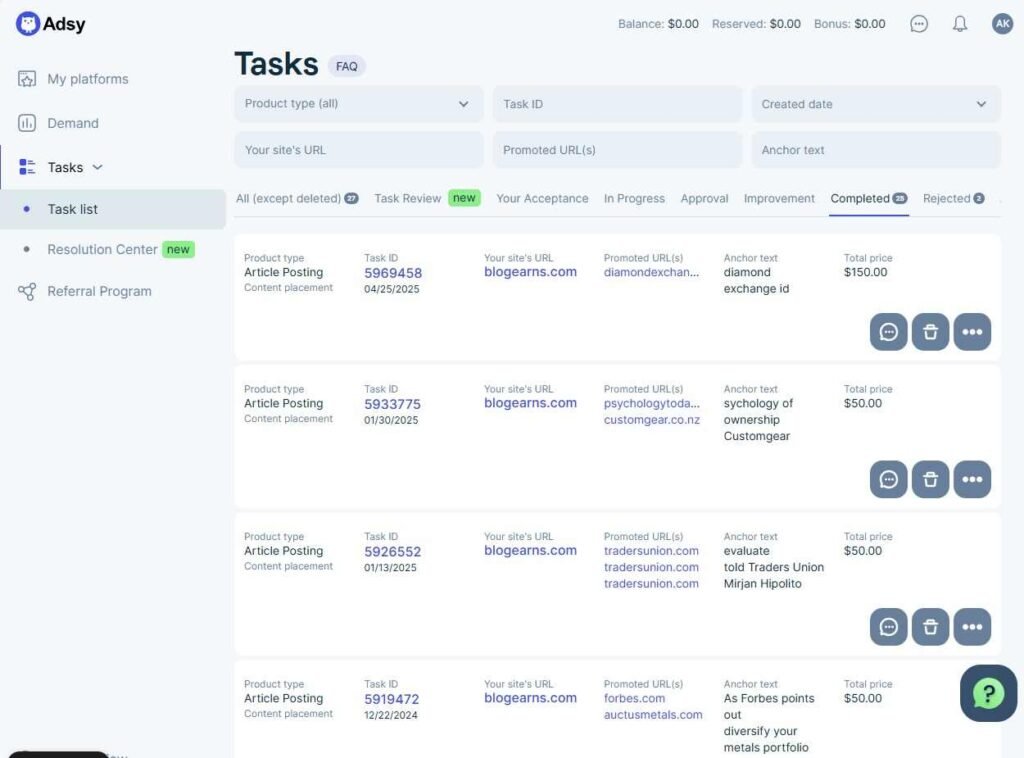
- Workflow Management: Tasks can be created, tracked, reviewed, and managed through a centralized dashboard.
Potential Limitations of Adsy
- Large Inventory Requires Careful Vetting: A large marketplace creates choice, but users must still evaluate publishers individually.
- Metrics Can Be Misinterpreted: DA, DR, and traffic numbers should not be used as the only indicators of placement quality.
- Prices Vary Significantly: Costs depend on publishers and placement requirements, making budget planning more complex for large campaigns.
- Editorial Quality Can Vary: Because each publisher is different, the quality of content and publication standards may vary across placements.
- Purchases Require Attention Before Approval: Adsy’s current FAQ states that buyers should carefully review task results and work with media partners to address issues because purchases are generally treated as final and non-refundable once made.
This makes pre-order research particularly important.
Is Adsy Legit?
Based on its long-running marketplace presence, publicly available platform documentation, active product development, and current third-party customer reviews, Adsy appears to be an established guest posting and content placement marketplace.
However, “legit” and “automatically right for every campaign” are not the same thing.
The marketplace model means the quality of your experience can depend significantly on the individual publisher and placement selected.
Recent third-party reviews show generally positive sentiment regarding the platform’s filtering, publisher selection, workflow, and support, while some negative reviews raise concerns about account balances, payment processes, or individual service experiences. At the time of review, Adsy had a 4.5 out of 5 TrustScore on Trustpilot based on 244 reviews, but individual experiences vary and ratings can change over time.
The most realistic conclusion is that Adsy is a legitimate marketplace tool, but it should be used with a proper publisher-vetting process.
- Do not outsource your judgment to the marketplace.
- Use the marketplace to discover opportunities.
- Then evaluate those opportunities independently.
Who Should Use Adsy?
Adsy may be a good fit for:
- SEO agencies managing multiple link-building campaigns.
- Businesses looking for content placement opportunities without performing all outreach manually.
- Affiliate websites seeking relevant editorial exposure.
- International brands targeting publishers in multiple countries and languages.
- Content marketers who want writing and placement options within one workflow.
- Website owners and publishers interested in monetizing their websites through paid content placements.
The platform may be less suitable for users who want a completely hands-off link-building service with no publisher evaluation responsibility.
Self-service marketplaces generally provide greater control, but that control requires more research.
Final Verdict: Is Adsy Worth Using?
Adsy is worth considering for marketers who want access to a large, flexible guest posting and content placement marketplace.
Its strongest advantages are the size of its inventory, advanced filtering options, international coverage, multiple placement products, and marketplace performance information.
The platform is particularly useful when you already understand how to evaluate websites and want to reduce the time spent on manual outreach.
- The main caution is equally important.
- Do not select placements based solely on Domain Rating, Domain Authority, or price.
- A good Adsy campaign requires the same strategic thinking as any other link-building campaign.
- Prioritize relevance.
- Check real traffic and audience quality.
- Review the website manually.
- Study the publisher’s performance.
- Inspect previous examples.
- Make sure the link placement makes sense.
- Then compare the price against the expected value.
Used carefully, Adsy can be a practical tool for scaling content placements and reducing outreach workload. Used carelessly, it can become another large marketplace where attractive metrics disguise poor placement quality.
The marketplace provides the options.
The strategy determines whether those options create meaningful results.
Frequently Asked Questions About Adsy
| What is Adsy? |
|---|
| Adsy is a content marketing and guest posting marketplace that connects advertisers with website owners and media partners offering content placement opportunities. Advertisers can search for websites, review available metrics, and order services such as article posting, link insertion, and writing and placement. |
| How does Adsy work? |
| You create an account, search the marketplace for websites that match your requirements, select a placement option, create a task with your content or link requirements, and track the order through the platform. The exact workflow can vary depending on the product selected. |
| How much does Adsy cost? |
| Adsy does not have one fixed price for all placements. Individual website owners and publishers offer placements at different prices. Current official information indicates that users can access the marketplace after an initial top-up, with promotional access currently starting from $25, while the actual cost of placements depends on the selected website and service. |
| Does Adsy offer guest post writing services? |
| Yes. Adsy offers a Writing & Placement option for selected placements. The cost can depend on the publisher and requested content length. Additional charges may apply if you request more content than the base article size included with the placement. |
| Can I use Adsy for link insertion? |
| Yes. Adsy offers link insertion opportunities where a link can be integrated into existing content, subject to the selected publisher and placement requirements. |
| How many websites are available on Adsy? |
| Adsy currently promotes access to more than 150,000 websites in its marketplace. The number of opportunities visible to a user can vary depending on filters, product type, country, language, and other search criteria. |
| Are all Adsy websites high quality? |
| No marketplace should be treated as though every individual publisher offers the same level of quality. Advertisers should evaluate each website based on topical relevance, traffic quality, editorial standards, content quality, publisher performance, and price. |
| Is Adsy good for SEO agencies? |
| Adsy can be useful for SEO agencies because it provides a large inventory, multiple filters, task management tools, and opportunities across different niches and countries. Agencies should still maintain their own publisher-vetting standards before placing orders. |
| Can I get a refund on Adsy? |
| Adsy’s current FAQ states that purchases are generally final and non-refundable, and users are encouraged to work with media partners to resolve issues through the task process. Buyers should therefore review placement requirements and publisher suitability carefully before placing an order. |
| Is Adsy legitimate? |
| Adsy is an established content placement and guest posting marketplace with publicly available platform documentation and a significant number of user reviews. However, individual results can vary because advertisers work with different publishers and placement opportunities. |
| Is Adsy better than manual guest post outreach? |
| It depends on your campaign. Adsy can save time by providing a centralized marketplace and reducing the need to discover and contact publishers individually. Manual outreach may still be preferable when you want to build direct editorial relationships with highly specific publications. |
| What should I check before buying a placement on Adsy? |
| Before ordering, check topical relevance, website quality, organic traffic, audience geography, existing content, outbound link patterns, publisher performance, placement context, link attributes, and price. Avoid selecting websites based on a single SEO metric. |