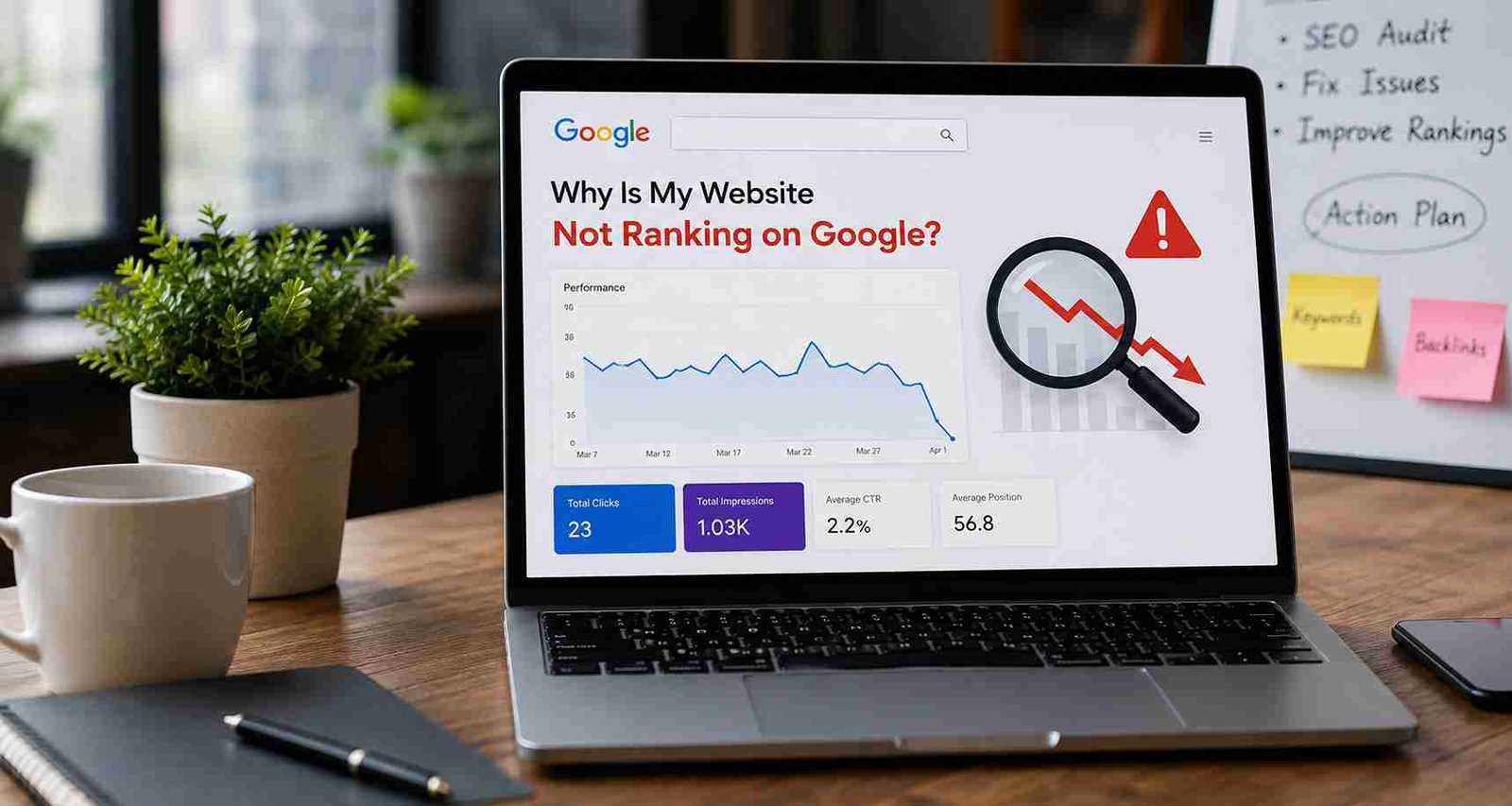
You publish a well-written article, optimize the title, add keywords, submit the URL to Google, and wait for traffic. Days pass. Then weeks. Your website not ranking on google – fix it may receive a few impressions, but the clicks never arrive.
This is one of the most frustrating parts of SEO.
The problem is that publishing a page does not guarantee that Google will rank it. Google has to discover the page, crawl it, understand what it is about, decide whether it is eligible for search results, compare it with competing pages, and determine whether it deserves to appear prominently for a particular query. This is a common scenario for the website not ranking on google – fix it.
If your website is not ranking on Google, there is usually a reason. Sometimes the problem is technical. Sometimes the page does not satisfy search intent. Sometimes the keyword is too competitive. In other cases, Google has indexed the page but simply does not consider it strong enough to rank prominently.
The good news is that ranking problems can usually be diagnosed.
This guide explains the most common reasons a website fails to rank on Google and, more importantly, what you can do about them.
First, Understand What “Not Ranking” Actually Means
Before changing your SEO strategy, determine what “not ranking” means in your specific situation.
A website can fail to rank in several different ways.
Your page may not be indexed at all. It may be indexed but ranking beyond the first few pages. It may rank for unexpected keywords instead of your target keyword. It may receive thousands of impressions but very few clicks. Or it may have previously ranked well and then experienced a significant decline.
These are different problems and require different solutions.
For example, if Google has not indexed your page, publishing another 2,000 words will probably not solve the problem. If the page is indexed but sitting at position 47, the issue may be content quality, search intent, authority, competition, internal linking, or several factors working together.
That is why the first step should always be diagnosis rather than rewriting everything.
Check Whether Google Has Indexed Your Page
One of the first things to investigate is indexing.
A page cannot generate organic Google traffic if it is not eligible to appear in Google’s search index.
The easiest way to investigate this is through Google Search Console. Open the URL Inspection tool and enter the exact URL of the page you want to investigate.
If Google reports that the URL is indexed, your problem is probably not basic indexing.
If it says the URL is not indexed, look at the reason provided.
You might see situations such as:
- Crawled but currently not indexed
- Discovered but currently not indexed
- Page with redirect
- Duplicate page
- Excluded by a noindex directive
- Blocked by robots.text
- Server-related crawling problems
- Alternate page with proper canonical tag
Each one points toward a different technical or content issue.
Do not assume that requesting indexing will automatically make a page rank. The indexing request simply asks Google to crawl and consider the page. It does not provide a ranking guarantee.
Your Page May Not Match Search Intent
This is one of the biggest reasons otherwise well-written content fails to rank.
Search engines do not simply match keywords. They try to understand what a searcher wants.
Consider the query:
“best WordPress hosting”
A person searching this phrase is probably looking for comparisons, recommendations, pricing, features, performance information, and potentially alternatives.
If your page is titled “What Is Web Hosting?” and spends 2,000 words explaining servers, it may contain the phrase “WordPress hosting” several times, but it does not satisfy the likely intent behind the query.
Now consider:
“how to install WordPress”
A searcher wants instructions.
An article that spends most of its introduction discussing the history of WordPress is unlikely to be the best result, even if the content is accurate.
This is why keyword optimization without intent optimization often produces disappointing results.
Before creating or updating an article, search the target keyword and study the pages already ranking.
Look at what type of content Google is rewarding.
Are the results:
- Tutorials?
- Product comparisons?
- Definitions?
- Reviews?
- Original research?
- Step-by-step guides?
- Category pages?
- Videos?
- Tools?
Your article should satisfy the underlying need better than competing pages, not simply repeat the same keyword more frequently.
The Keyword May Be Too Competitive
Sometimes the problem is not that your content is bad.
The keyword may simply be too difficult for your website at its current level of authority.
Imagine a new website publishing an article targeting “SEO.”
That keyword is extraordinarily broad and competitive. It is unlikely that a new website will immediately outrank established SEO publications, software companies, educational resources, and websites with years of accumulated authority.
A better approach is to target more specific queries.
Instead of immediately targeting:
SEO
you might target:
SEO for new bloggers
Then:
how to do SEO for a new blog
Then:
how to find low competition keywords for a new blog
As your website builds topical relevance and authority, you can gradually pursue broader keywords.
This is where long-tail keyword research becomes extremely valuable.
The goal is not to find keywords nobody searches for. The goal is to identify searches where your website has a realistic opportunity to provide the best answer.
Your Content May Not Be Comprehensive Enough
Word count is not a ranking factor by itself.
A 1,000-word article can outperform a 5,000-word article if it provides a better answer.
However, thin content can still be a problem when it fails to cover important aspects of a topic.
Suppose someone searches:
“How to improve website SEO”
An article containing only a few generic recommendations such as “use keywords,” “build backlinks,” and “write quality content” is unlikely to provide much value.
A stronger resource would explain keyword research, search intent, title optimization, internal linking, technical SEO, page experience, content updating, structured data where appropriate, backlinks, measurement, and common mistakes.
The objective should be completeness without unnecessary padding.
Every section should help the reader accomplish something.
Do not add paragraphs merely to hit 3,000 words. Google does not award trophies for hitting an arbitrary word count.
Your Content May Be Helpful but Not Distinctive
Another common problem is creating content that is technically correct but almost identical to hundreds of existing pages.
Search “how to write a blog post.”
You will find countless articles explaining similar concepts:
Choose a topic. Research keywords. Write an introduction. Add headings. Optimize the title. Add images. Publish.
If your article says essentially the same thing in slightly different words, there may be little reason for Google to prefer it.
To compete, add something distinctive.
That could include original examples, first-hand observations, screenshots, experiments, data, case studies, expert insights, useful templates, calculations, comparisons, or a genuinely better explanation.
For example, instead of simply explaining organic CTR, you could analyze several hypothetical Search Console scenarios and demonstrate why a page with 50,000 impressions and a 1% CTR deserves a different strategy from a page with 1,000 impressions and a 5% CTR.
Useful specificity makes content more valuable.
Your Website May Lack Topical Authority
Google evaluates individual pages, but your website’s broader topical relevance can also matter.
Imagine you publish one article about technical SEO and then expect it to compete against websites that have hundreds of interconnected resources covering crawling, indexing, canonical tags, structured data, Core Web Vitals, redirects, JavaScript SEO, XML sitemaps, robots.text, log files, and international SEO.
Your single article may be excellent, but the competing website has built a much stronger topical ecosystem.
This is where content clusters become powerful.
Instead of publishing unrelated articles, create connected resources around a central subject.
For example, an SEO cluster could contain:
Pillar: Complete SEO Guide
Supporting content could cover keyword research, search intent, on-page SEO, technical SEO, internal linking, backlinks, Google Search Console, SEO audits, content optimization, indexing problems, organic CTR, and ranking drops.
These pages should naturally link to one another.
The result is a website that demonstrates depth rather than simply collecting unrelated articles.
Your Internal Linking May Be Weak
Internal links are one of the simplest SEO improvements that many websites underuse.
When you publish a new article, do not leave it isolated.
Find older relevant pages that can naturally link to it.
For example, if you publish:
Why Is My Website Not Ranking on Google?
you might link to related resources about:
- Keyword research
- On-page SEO
- Google Search Console
- Technical SEO
- Internal linking
- Updating old content
- Organic CTR
The new article can also link back to your broader SEO guide.
This creates a logical network.
Internal links help users discover related information and help search engines understand relationships between pages.
But avoid turning every sentence into a hyperlink. Internal linking should feel natural and useful.
Your Website May Have Technical SEO Problems
Technical SEO problems can prevent search engines from properly accessing or understanding your website.
Common issues include incorrect robots.text directives, accidental noindex tags, poor canonicalization, broken redirects, duplicate URLs, server errors, slow pages, poor mobile usability, and problematic site architecture.
For example, you could accidentally add a noindex directive to a page you actually want Google to rank.
The content could be brilliant.
Google still will not treat that page as a normal ranking candidate.
Technical SEO is therefore worth checking before spending weeks rewriting content.
Your technical audit should examine crawling, indexing, canonical URLs, redirects, sitemap configuration, robots.text, mobile usability, HTTPS, Core Web Vitals, broken links, duplicate content, and important server errors.
Your Website May Be Too New
New websites often expect rankings to appear quickly.
SEO rarely works like that.
A new website starts with little historical evidence, few backlinks, limited topical coverage, and little established search visibility.
That does not mean a new website cannot rank.
It means expectations should be realistic.
You may see impressions before meaningful clicks. You may rank for very specific long-tail queries before appearing for competitive terms. Some pages may take weeks or months to gain traction.
Instead of asking only, “Why am I not ranking number one?” look for smaller signals of progress.
Are impressions increasing?
Are more keywords appearing in Search Console?
Are some pages moving from positions 50–100 toward positions 20–40?
Are long-tail queries beginning to generate clicks?
These can indicate that your content is gaining visibility even before major traffic arrives.
Your Website May Have Very Few Quality Backlinks
Links are not the entire SEO equation, but they can still matter, particularly when you’re competing in difficult search results.
A page may be excellent and still struggle to compete against established websites with strong authority and many relevant links.
The answer is not to buy thousands of low-quality backlinks.
Instead, work on earning relevant mentions.
Create resources that people have a reason to reference.
Original research, useful statistics, calculators, studies, detailed guides, free tools, industry data, and genuinely useful resources can naturally attract links.
You can also promote valuable content to relevant publications, communities, journalists, creators, and website owners where appropriate.
The quality and relevance of links matter much more than simply accumulating a large number.
Your Website Could Have Duplicate or Cannibalizing Content
Another reason a page may struggle is that your own website has multiple pages targeting the same intent.
Imagine you have three articles:
Best SEO Tools
Top SEO Tools
Best SEO Tools for Bloggers
If all three pages target essentially the same audience and keywords, they may compete with one another.
This is often called keyword cannibalization, although the underlying problem can vary.
Before publishing another article, search your own site.
Ask:
Do I already have a page that answers this query?
If the answer is yes, determine whether you should update that page, expand it, consolidate multiple pages, or create a genuinely different resource.
More URLs do not automatically mean more traffic.
Sometimes fewer, stronger pages perform better.
Your Titles May Be Losing the Click
Ranking is only half the battle.
Suppose your page appears in position four but receives almost no clicks.
The problem could be the search snippet.
Your title should communicate relevance and give the searcher a reason to investigate the result.
Compare:
SEO Guide
with:
SEO for Beginners: How to Get Your First Google Rankings
The second title communicates audience, topic, and outcome more clearly.
However, avoid misleading clickbait.
A title that attracts clicks but fails to satisfy the visitor can damage the user experience.
The best SEO title creates a clean promise and then delivers on it.
Your Meta Description May Need Improvement
Meta descriptions generally do not function as a direct ranking factor, but they can influence how searchers perceive your result and whether they click.
A useful description should summarize the page accurately and explain its value.
Instead of:
Learn about SEO and improve your website.
you could write:
Discover why your website isn’t ranking on Google and learn practical ways to fix indexing, search intent, content, technical SEO, and authority issues.
The second version gives the searcher much more information.
Do not stuff the description with keywords. Write it for humans.
Your Content May Be Outdated
SEO changes.
Search behavior changes.
Products change.
Algorithms evolve.
Statistics become old.
Screenshots become obsolete.
A page that performed well two years ago may gradually lose relevance.
Look for signs that an article needs updating.
Perhaps the ranking pages now cover topics your article ignores. Maybe your examples are outdated. Maybe links are broken. Maybe screenshots show an old interface. Maybe competitors provide significantly more useful information.
Updating an existing article can sometimes be more valuable than publishing another article from scratch.
But an update should be meaningful.
Changing a few sentences and the publication date is not a real content refresh.
Re-evaluate the search intent, competitors, structure, examples, internal links, facts, screenshots, and overall usefulness.
Your Website May Have Poor Site Architecture
A search engine should be able to understand the relationship between your important pages.
If your navigation is chaotic and important content is buried several clicks deep, both users and search engines may have a harder time discovering it.
Build logical categories.
For a blogging website, a structure could look like:
Blogging
→ Start a Blog
→ Content Strategy
→ Blog Traffic
→ Monetization
SEO
→ Keyword Research
→ On-Page SEO
→ Technical SEO
→ Search Console
→ Link Building
WordPress
→ Themes
→ Plugins
→ Speed
→ Security
→ Troubleshooting
This makes the website easier to navigate and creates natural opportunities for internal linking.
Your Page Experience Could Be Poor
Content quality comes first, but technical performance still matters.
If your page takes too long to load, shifts around while loading, contains intrusive interstitials, or is difficult to use on mobile devices, visitors may have a poor experience.
Check your pages across desktop and mobile.
Look at:
- Loading performance
- Core Web Vitals
- Mobile usability
- Font readability
- Image sizes
- Layout stability
- Intrusive pop-ups
- Navigation
- Ad placement
A beautiful article that takes forever to load is not exactly winning the marathon.
Optimize images, reduce unnecessary scripts, use efficient caching, review plugins, and make sure your hosting environment can handle your traffic.
You May Be Publishing Too Many Weak Articles
More content is not always better.
Publishing five shallow articles every day can create a website full of pages that provide little unique value.
A better approach is to publish fewer, stronger resources and connect them through internal links.
Before publishing, ask:
Does this article deserve to exist?
Does it satisfy a real search intent?
Does it provide something better or different from existing results?
Does it fit one of my site’s main topical areas?
Can I support it with internal links?
Can it become a useful resource rather than another page competing for the same keywords?
If you cannot answer those questions confidently, the topic may need more research.
How to Diagnose Your Ranking Problem
Rather than guessing, use a structured process.
Start with Google Search Console.
Check whether the URL is indexed.
If it isn’t indexed, investigate the indexing reason.
If it is indexed, check the queries generating impressions.
If impressions are near zero, investigate indexing, relevance, keyword selection, and discoverability.
If impressions are high but clicks are low, investigate your title, snippet, SERP position, and search intent.
If the page ranks around positions 8–20, focus on improving content quality, satisfying intent more completely, strengthening internal links, improving the page’s authority, and updating the content where necessary.
If rankings suddenly declined, compare the page with the current search results and investigate whether competitors have become more useful, the intent has changed, or the page has become outdated.
This approach turns SEO from guesswork into diagnosis.
What Should You Do If Your Website Is Getting Impressions but No Clicks?
This deserves special attention because it is one of the most actionable SEO situations.
If Google is showing your website but users aren’t clicking, you already have some visibility.
That means the next question is not necessarily:
“Why doesn’t Google know my website exists?”
It may be:
“Why are searchers choosing another result?”
Look at the query.
Then examine:
Position: A result at position 50 naturally receives fewer clicks than one at position 3.
Title: Does it clearly communicate the answer?
Search intent: Does the page actually satisfy what people want?
Competition: Are competing titles more compelling?
Brand recognition: Are established websites dominating the results?
Content freshness: Does your page look outdated compared with competing pages?
Improving CTR can be valuable, but do not obsess over CTR in isolation. Moving a page from position 30 to position 8 can be much more significant than making a tiny improvement to its title.
What If Your Website Suddenly Lost Rankings?
A ranking drop requires a different investigation.
Do not immediately delete the page.
First determine whether the decline is:
- Sitewide
- Limited to one category
- Limited to specific pages
- Limited to specific keywords
- Temporary
- Connected to a major search change
Compare your Search Console data before and after the decline.
Look at clicks, impressions, average position, queries, pages, and countries.
Then manually examine the current search results.
Ask what changed.
Are competitors answering the query better?
Has the search intent shifted?
Are newer pages dominating?
Is your content outdated?
Did you make technical changes?
Did URLs or canonical tags change?
Did internal links disappear?
Did your site experience outages?
The answer is usually found by comparing the old state with the new one rather than making random SEO changes.
How to Actually Get Your Website Ranking
There is no magic switch that tells Google to rank a page.
Instead, build a website that consistently demonstrates relevance, usefulness, technical accessibility, and topical depth.
Start with the fundamentals.
Choose realistic keywords.
Understand search intent.
Create genuinely useful content.
Build topical clusters.
Strengthen internal links.
Keep important pages technically accessible.
Improve site speed and mobile experience.
Update content when it becomes outdated.
Build legitimate authority through valuable resources and relevant mentions.
Then measure what happens.
SEO is an iterative process.
You publish.
Google gathers information.
Users interact with the result.
You study the data.
You improve the page.
The cycle repeats.
The websites that eventually build strong organic traffic are rarely the ones that discover one secret trick. They are usually the ones that consistently make their content, website structure, technical foundation, and user experience better.
Final Thoughts
If your website is not ranking on Google, don’t immediately assume that Google has “blocked” your site or that you need more keywords.
The real issue could be indexing, search intent, keyword difficulty, content quality, topical authority, internal linking, technical SEO, backlinks, site architecture, outdated information, poor snippets, or simply the fact that your website is still building authority.
The most important thing is to identify which problem you actually have.
Start with Google Search Console. Confirm indexing. Study the queries producing impressions. Examine your current rankings. Compare your content with the pages that Google currently rewards. Then improve the weakest part of the equation.
And remember one important principle:
SEO is not about convincing Google that your page deserves to rank. It is about creating the page that best deserves to rank for the searcher’s specific need.
When your content genuinely answers that need better, your technical foundation is sound, and your website develops authority around the subject, organic visibility has a much stronger foundation to grow.