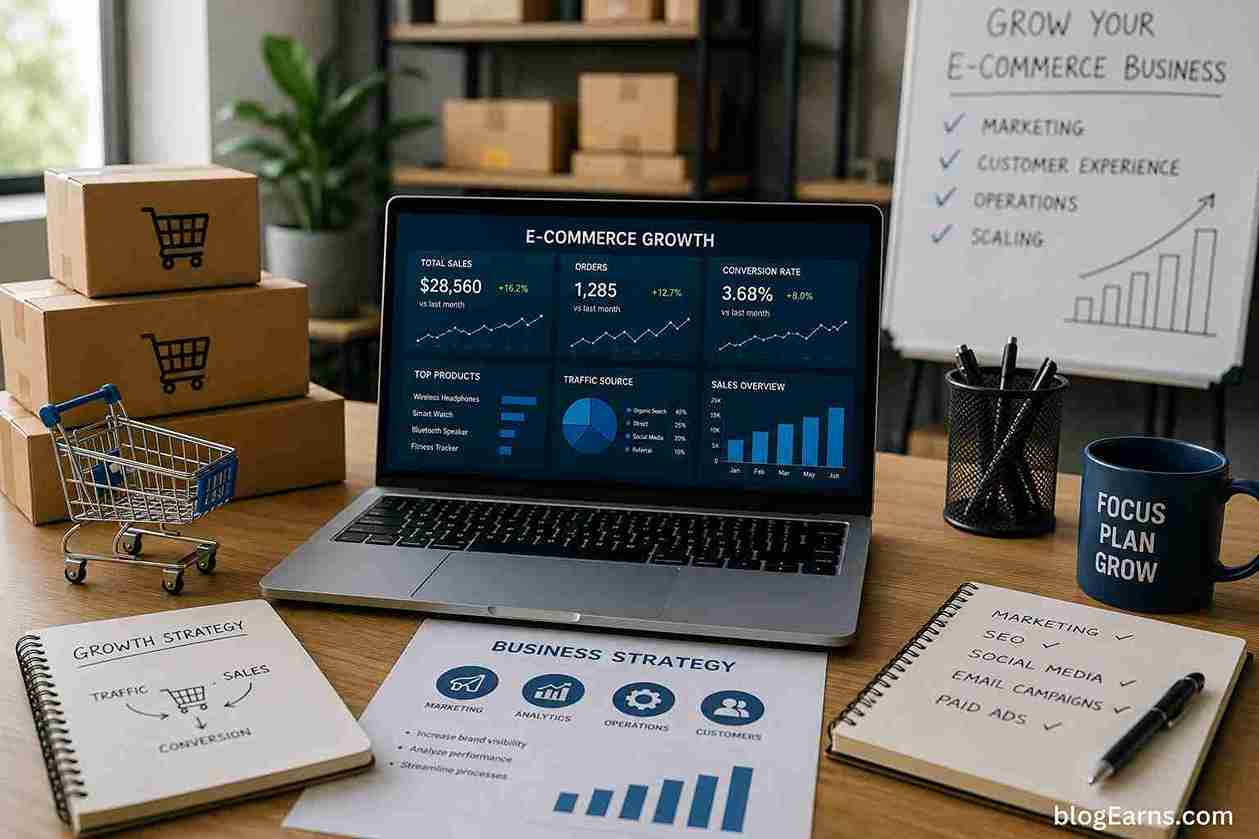
The eCommerce industry continues to grow at an impressive pace, creating opportunities for businesses of all sizes to reach customers around the world. While launching an online store has become easier than ever, successfully scaling an eCommerce business remains a significant challenge. Growth brings increased customer demand, higher order volumes, more complex operations, and rising competition. Without the right tools and strategies, businesses can quickly find themselves struggling to keep up.
Many online stores experience early success but face difficulties when they begin expanding. Processes that worked efficiently for a small customer base may become bottlenecks as sales increase. Customer service requests grow, inventory management becomes more complicated, and marketing efforts require greater precision. To scale successfully, eCommerce businesses must create systems that support growth while maintaining efficiency and customer satisfaction.
Technology plays a central role in this process. Modern digital tools help businesses automate tasks, improve decision-making, enhance customer experiences, and streamline operations. At the same time, strategic planning ensures that growth remains sustainable and profitable.
As competition in online retail continues to intensify, businesses that combine the right technology with effective growth strategies are best positioned to succeed.
Understanding What Scaling Really Means
Many business owners associate scaling with simply increasing sales. While revenue growth is certainly important, true scalability involves growing the business without causing operational inefficiencies or significantly increasing costs.
A scalable eCommerce business can handle larger order volumes, increased website traffic, and growing customer demands without compromising service quality. It has systems in place that allow operations to expand smoothly and predictably.
Scaling requires more than attracting new customers. It involves optimizing every aspect of the business, from marketing and inventory management to customer support and fulfillment.
Businesses that focus solely on sales growth without strengthening their operational foundation often encounter challenges that limit long-term success.
Building a Strong eCommerce Platform
The foundation of any online business is its eCommerce platform.
As a business grows, the platform must be capable of handling increasing traffic, product catalogs, transactions, and customer interactions. Performance issues such as slow loading speeds, checkout failures, or downtime can negatively impact sales and customer trust.
Modern eCommerce platforms provide scalability through cloud infrastructure, flexible integrations, and advanced functionality. They allow businesses to expand product offerings, support multiple sales channels, utilize sales automation, and manage growing customer bases more effectively.
A reliable platform not only supports current operations but also provides the flexibility needed for future growth.
For businesses evaluating platform options, investing in BigCommerce design services early ensures the storefront is built for performance and scalability from day one.
Investing in a scalable foundation early can prevent costly migrations and disruptions later.
Leveraging Customer Relationship Management Tools
Customer retention is often more profitable than constantly acquiring new customers.
As an eCommerce business grows, managing customer relationships manually becomes increasingly difficult. Customer Relationship Management (CRM) systems help centralize customer data and provide a complete view of each customer’s journey.
CRM platforms allow businesses to track purchases, monitor customer interactions, segment audiences, and personalize communication.
With better customer insights, businesses can create targeted marketing campaigns, improve customer support, and identify opportunities for upselling or cross-selling.
Strong customer relationships are a key driver of sustainable growth, making CRM technology an essential tool for scaling.
Using Data Analytics to Drive Growth
Successful eCommerce businesses rely heavily on data.
Every customer interaction generates information that can help improve decision-making. Website traffic, conversion rates, purchasing behavior, customer demographics, and marketing performance all provide valuable insights.
Analytics tools help businesses understand what is working and where improvements are needed.
For example, analytics can reveal which products generate the highest revenue, which marketing channels deliver the best return on investment, and where customers abandon the purchasing process.
Rather than relying on assumptions, business leaders can make informed decisions based on real customer behavior.
As competition increases, data-driven strategies become increasingly important for maintaining growth and profitability.
Automation for Operational Efficiency
One of the biggest challenges of scaling is managing increasing workloads without dramatically increasing costs.
Automation helps solve this problem by handling repetitive tasks that would otherwise require significant manual effort.
Order confirmations, inventory updates, shipping notifications, email marketing campaigns, customer follow-ups, and reporting processes can all be automated.
This not only improves efficiency but also reduces the likelihood of human error.
Employees can focus on strategic initiatives and customer engagement rather than spending time on routine administrative tasks.
Automation allows businesses to handle growth more effectively while maintaining consistent service quality.
Enhancing Inventory Management
Inventory management becomes increasingly complex as product catalogs expand and order volumes increase.
Poor inventory control can lead to stock shortages, overselling, delayed shipments, and dissatisfied customers.
Modern inventory management software provides real-time visibility into stock levels across multiple channels and locations. Businesses can track inventory movements, forecast demand, and automate replenishment processes.
Advanced systems use analytics and artificial intelligence to predict future inventory needs based on historical sales patterns and seasonal trends.
Efficient inventory management helps businesses reduce costs while ensuring customers receive products on time.
For growing eCommerce companies, inventory accuracy is essential for maintaining profitability and customer satisfaction.
Improving Customer Service at Scale
Customer expectations continue to rise, particularly in online retail.
Consumers expect fast responses, personalized support, and seamless experiences throughout their purchasing journey. As customer bases grow, maintaining high service standards becomes more challenging.
Customer service platforms help businesses manage inquiries across email, chat, social media, and phone channels from a centralized interface.
Artificial intelligence is also transforming customer support. AI-powered chat solutions can answer common questions, provide order updates, and assist customers around the clock.
These tools help businesses respond more quickly while reducing pressure on support teams.
Excellent customer service remains one of the most effective ways to build loyalty and encourage repeat purchases.
Investing in Marketing Technology
Marketing is often the engine that drives eCommerce growth.
However, scaling marketing efforts effectively requires more than increasing advertising budgets. Businesses need tools that help them reach the right audiences, measure performance, and optimize campaigns.
Marketing automation platforms allow businesses to manage email campaigns, audience segmentation, social media scheduling, and customer journeys more efficiently.
Artificial intelligence is playing an increasingly important role in marketing by helping businesses personalize content and predict customer behavior.
AI-powered recommendations can improve product discovery, while predictive analytics helps marketers identify high-value customer segments.
Technology enables businesses to scale marketing activities while maintaining relevance and personalization.
The Growing Role of AI in eCommerce
Artificial intelligence has become one of the most influential technologies in modern eCommerce.
AI helps businesses analyze large amounts of data, automate decision-making, and improve customer experiences. Recommendation engines, dynamic pricing systems, fraud detection tools, and intelligent search capabilities are just a few examples of AI applications in online retail.
AI is also transforming content creation.
Many businesses now use AI tools to generate product descriptions, marketing copy, customer emails, and social media content more efficiently.
AI video generator is becoming increasingly valuable as well. Online retailers can create product demonstrations, promotional videos, tutorials, and advertising content without the time and expense associated with traditional video production.
As competition for consumer attention increases, AI-powered content creation offers a scalable way to engage customers and strengthen brand visibility.
Optimizing the Customer Experience
A smooth customer experience is essential for eCommerce success.
Even small friction points can impact conversion rates and customer satisfaction. Slow-loading websites, complicated checkout processes, poor navigation, and limited payment options can all lead to abandoned purchases.
Businesses should continuously evaluate and improve the shopping experience.
Website performance, mobile optimization, personalized recommendations, streamlined checkout processes, and transparent shipping information all contribute to stronger customer engagement.
Analytics tools help identify areas where customers encounter obstacles, allowing businesses to make targeted improvements.
As businesses scale, maintaining a positive customer experience becomes increasingly important for sustaining growth.
Expanding Through Omnichannel Selling
Today’s consumers interact with brands across multiple channels.
Many customers discover products through social media, compare options on marketplaces, and complete purchases through online stores. Businesses that rely on a single sales channel may miss valuable opportunities.
Omnichannel selling allows businesses to reach customers wherever they prefer to shop.
Modern eCommerce tools help integrate websites, online marketplaces, social media platforms, and physical retail operations into a unified ecosystem.
This approach improves brand visibility, expands market reach, and creates more opportunities for customer engagement.
Businesses that successfully manage multiple sales channels often achieve stronger and more sustainable growth.
Strengthening Cybersecurity and Trust
As online transactions increase, so do cybersecurity risks.
Customers expect businesses to protect their personal and financial information. A single security breach can damage trust and negatively impact brand reputation.
Cybersecurity tools help protect websites, customer data, and payment systems from threats.
Businesses should implement secure payment processing, multi-factor authentication, regular software updates, and proactive monitoring solutions.
Trust plays a major role in eCommerce success, and strong security practices help reinforce customer confidence.
Protecting customer information should remain a top priority throughout the scaling process.
Developing a Long-Term Growth Strategy
Technology alone is not enough to guarantee success.
Businesses must also develop clear strategies for growth. This includes understanding target audiences, monitoring market trends, evaluating competitors, and identifying opportunities for expansion. Professionals pursuing roles in this space should also reflect these capabilities in an eCommerce resume, particularly skills related to analytics, digital marketing, customer experience, inventory systems, and operational growth.
Scaling requires a balance between growth and operational stability.
Organizations should regularly assess performance, refine processes, and invest in technologies that align with long-term objectives.
Rather than chasing every new trend, successful businesses focus on building systems that support sustainable growth and adaptability.
A strategic approach helps ensure that expansion remains manageable and profitable.
Final Thoughts
Scaling an eCommerce business requires more than increasing sales—it requires building the systems, processes, and technology needed to support long-term growth. From robust eCommerce platforms and CRM systems to data analytics, automation, AI-powered tools, and customer service solutions, the right resources can help businesses operate more efficiently while delivering exceptional customer experiences. As competition continues to intensify in online retail, organizations that invest in scalable technology and data-driven strategies will be better positioned to manage growth, improve profitability, and build lasting customer relationships. Success in eCommerce is no longer just about selling products; it is about creating an efficient, adaptable, and customer-focused business capable of thriving in a rapidly evolving digital marketplace.