
Best Time to Post YouTube Shorts (And Why Most Creators Get It Wrong)
Best time to post YouTube Shorts: You spent two hours shooting, editing, trimming, and perfecting your YouTube Short. You hit publish — and it gets 47 views. Meanwhile, some random 15-second clip of a cat knocking over a cup goes viral overnight. What gives?
Here’s the brutal truth: timing is not everything, but terrible timing can kill everything. The best time to post YouTube Shorts isn’t a magic number chiseled in stone. It’s a moving target shaped by your audience, your niche, your geography, and the ever-shifting behavior of the algorithm. But don’t worry — by the end of this article, you’ll know exactly how to find your ideal window and squeeze maximum performance out of every Short you upload.
Why Timing Actually Matters for YouTube Shorts
Before we get into the numbers, let’s understand why timing matters in the first place.
YouTube’s algorithm doesn’t just rank videos by quality. It ranks them by engagement velocity — meaning how quickly a video racks up views, likes, comments, and shares after it’s posted. If your Short gets a surge of engagement in the first 30–60 minutes, the algorithm interprets that as a signal of quality and pushes it to more feeds.
If you post at 3 AM when your audience is asleep, that initial velocity is flat. The algorithm doesn’t give it a second look. Your perfectly crafted Short dies in silence.
This is why the best time to post YouTube Shorts is less about a clock and more about catching your audience when they’re awake, scrolling, and primed to engage.
The General “Best Times” to Post YouTube Shorts
Let’s start with the broad data — gathered from creator analytics, third-party studies, and platform behavior research — before we get to the personalized strategy you actually need.
Best days to post:
- Friday, Saturday, and Sunday consistently outperform weekdays for Shorts. Weekend scrolling is high, and people have more idle time to binge short-form content.
- Thursday has emerged as a sleeper hit, especially for creators targeting working professionals who begin winding down before the weekend.
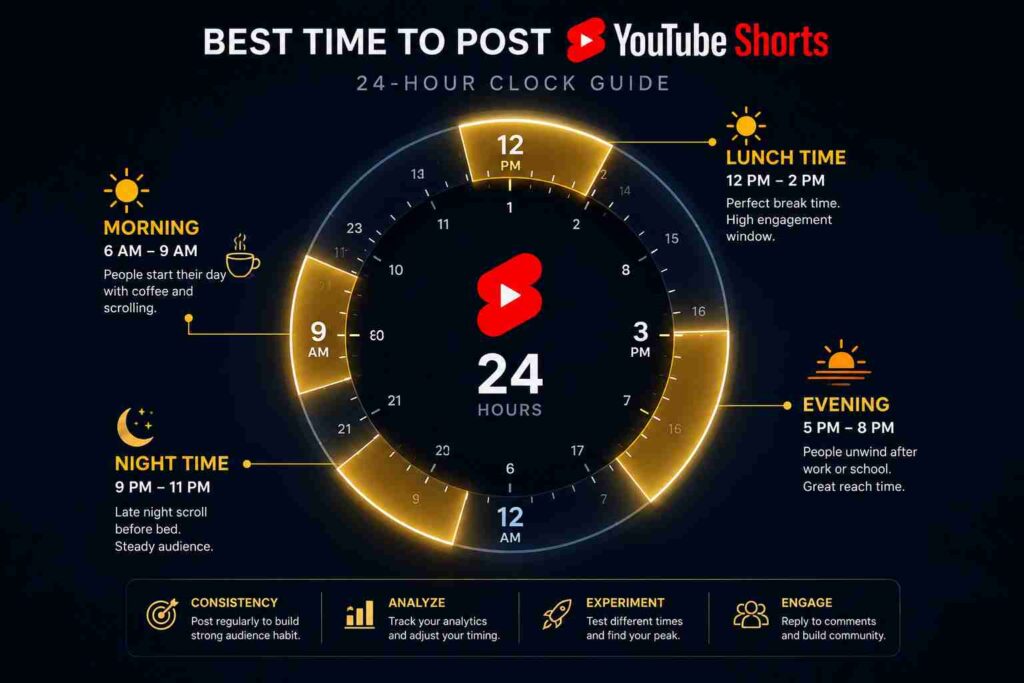
Best time slots (in the audience’s local timezone):
- 6 AM – 9 AM: Morning commuters, breakfast scrollers. High volume, moderate engagement. Good for motivational, educational, or news-related content.
- 12 PM – 2 PM: Lunch break traffic. One of the strongest windows for short-form content. People are looking to be entertained quickly, and Shorts fit perfectly.
- 5 PM – 8 PM: Post-work and after-school hours. This is arguably the golden window for YouTube Shorts. Engagement peaks during these hours across most niches.
- 9 PM – 11 PM: Late-night browsers. Strong for entertainment, lifestyle, humor, and gaming content. Slightly lower than the 5–8 PM window but still solid.

The Timezone Problem Nobody Talks About
Here’s a mistake that silently destroys countless creators’ analytics: posting in your timezone instead of your audience’s timezone.
If you’re based in Mumbai and 60% of your audience is in the United States, posting at 7 PM IST means your content drops at 6:30 AM Pacific Time or 9:30 AM Eastern. That’s not terrible — but it’s also not peak.
Before you pick a posting time, go to YouTube Studio → Analytics → Audience tab and check:
- Where your viewers are located geographically
- When your audience is most active (YouTube now shows an “When your audience is on YouTube” chart)
That data is more valuable than any generalized “best time” article — including this one. Use it.
Platform-Specific Behavior: Shorts vs. Long-Form Videos
YouTube Shorts don’t behave like regular YouTube videos. Here’s what makes them different from a timing perspective:
Shorts have a longer tail, but a faster burn. A well-optimized long-form video can gain traction weeks or months after posting. Shorts, by contrast, spike early or fade fast. This makes the initial posting window even more critical.
The Shorts feed is algorithm-curated, not subscriber-driven. Unlike regular videos that get emailed to subscribers, Shorts live inside the Shorts shelf and the dedicated Shorts tab. This means you’re competing with every other Short on the platform, not just creators in your niche. Getting into that initial engagement wave matters enormously.
Watch loops count. A viewer watching your Short twice counts as two views. This means your early engagement can compound quickly if you drop content when people have time to rewatch. Post during the 5–8 PM window and you catch people who are relaxed, not rushed.
Niche-Specific Best Times to Post YouTube Shorts
Your niche changes everything. Here’s a breakdown by category:
Fitness & Health: Post between 5 AM – 7 AM or 6 PM – 8 PM. Fitness audiences often work out in the morning or evening and consume content around those times.
Finance & Education: Weekday mornings work well, particularly 7 AM – 9 AM. This audience is commuting, listening, learning. Lunchtime also performs strongly — 12 PM – 1 PM.
Gaming: Late evening and night are king here — 8 PM to midnight, especially on weekends. Gaming audiences skew younger and stay up late.
Comedy & Entertainment: The broadest audience and one of the most forgiving for timing, but still peaks during the 5 PM – 10 PM window when people want to unwind.
Beauty & Fashion: Midday and early evening. 12 PM – 2 PM and 5 PM – 7 PM see strong engagement, especially from mobile-first audiences.
Food & Cooking: Late afternoon cooking inspiration peaks around 4 PM – 6 PM, right when people are thinking about dinner.
How to Find YOUR Actual Best Posting Time (Step-by-Step)
Stop guessing. Here’s a repeatable process to scientifically find your optimal upload time.
Step 1: Post consistently for 30 days. Without consistent data, you have nothing to analyze. Upload Shorts daily or at least 4–5 times per week.
Step 2: Vary your posting times intentionally. In your first 30 days, distribute posts across morning (7–9 AM), midday (12–2 PM), evening (5–8 PM), and night (9–11 PM). Track which slots you used.
Step 3: Review your data in YouTube Studio. After 30 days, go to each Short’s analytics and note: views in the first 24 hours, average view duration, and engagement rate (likes + comments relative to views).
Step 4: Identify patterns. Which time slots produced the highest 24-hour view counts? Which had the best engagement rates? Your best window is where both metrics overlap.
Step 5: Double down and test further. Once you identify your best window, post in that window for the next 30 days and compare. Refine from there.
This process takes 60–90 days but produces data that’s specific to your channel, your audience, and your niche. No blog post or YouTube video can replicate that.
Scheduling Tools to Stay Consistent

Consistency in posting time trains both the algorithm and your audience. Here are tools that make scheduling YouTube Shorts painless:
- YouTube Studio’s built-in scheduler: Free, reliable, and directly integrated. You can set an exact date and time.
- TubeBuddy: Offers tag and keyword tools alongside scheduling. Great for Shorts creators who also manage long-form content.
- VidIQ: Has timing recommendations based on your channel’s historical data and competitor analysis.
Set your uploads to go live automatically so you never accidentally post at the wrong time due to manual delay.
Common Timing Mistakes That Kill Your Views
Even with a solid strategy, small mistakes can wreck performance:
Posting too frequently at the wrong time: Flooding your channel with low-effort Shorts at bad hours trains the algorithm to deprioritize you. Quality + timing beats quantity alone.
Ignoring holidays and cultural events: Posting a fitness Short on Christmas morning? Everyone’s distracted. Align your content with your audience’s calendar.
Changing times randomly: Inconsistency confuses the algorithm. Pick 1–2 time windows and stick to them for at least 4 weeks before judging the results.
Posting right when a major platform event is happening: YouTube sometimes pushes major live events or Premieres that temporarily flood the Shorts feed. You can lose traction competing with that noise.
The Bigger Truth About YouTube Shorts Timing

Here’s something most creators won’t tell you: timing is a multiplier, not a miracle.
A mediocre Short posted at the perfect time will outperform that same mediocre Short posted at the wrong time — but it will never outperform a genuinely great Short with solid hooks, good audio, tight editing, and a strong call-to-action.
The best time to post YouTube Shorts is when your specific audience is online, your content is genuinely worth watching, and you’re consistent enough for the algorithm to trust your channel. Master all three of those, and watch what happens.
Your next step? Open YouTube Studio right now, pull up your audience analytics, and start building your personalized posting schedule. The data is already there. Use it.







I very delighted to find this internet site on bing, just what I was searching for as well saved to fav
Great information shared.. really enjoyed reading this post thank you author for sharing this post .. appreciated
Pretty! This has been a really wonderful post. Many thanks for providing these details.
I very delighted to find this internet site on bing, just what I was searching for as well saved to fav
Thanks for posting! API 650 tank jacking equipment is a must for safe erection.
I’m often to blogging and i really appreciate your content. The article has actually peaks my interest. I’m going to bookmark your web site and maintain checking for brand spanking new information.
You’re so awesome! I don’t believe I have read a single thing like that before. So great to find someone with some original thoughts on this topic. Really.. thank you for starting this up. This website is something that is needed on the internet, someone with a little originality!
Good post! We will be linking to this particularly great post on our site. Keep up the great writing
I very delighted to find this internet site on bing, just what I was searching for as well saved to fav