The Hidden Time Cost of Progress Notes in Hospital Medicine
Progress notes are a mandatory part of inpatient physician practice, but the time they require has grown well beyond what most physicians trained to expect. Between the documentation requirements for billing, the regulatory requirements for clinical record completeness, and the communication function notes serve for the care team, a single progress note for a complex inpatient can take fifteen to twenty minutes to write well.
Across a census of twenty patients, that documentation burden becomes the dominant administrative task in a hospitalist’s day. It competes with direct patient care time, extends shifts, and contributes meaningfully to the administrative burnout that characterizes hospital medicine as a specialty. The note is not optional, but the time it takes to produce is not fixed — and that is where automation creates real value.
The development of AI-assisted progress note generators has produced measurable improvements. One documented outcome is cutting charge capture time by up to 73% — a reduction that translates directly into hours recovered per physician per week, representing one of the most tangible ROI metrics available for billing technology investment in hospital medicine.
How Progress Note Generation Technology Works
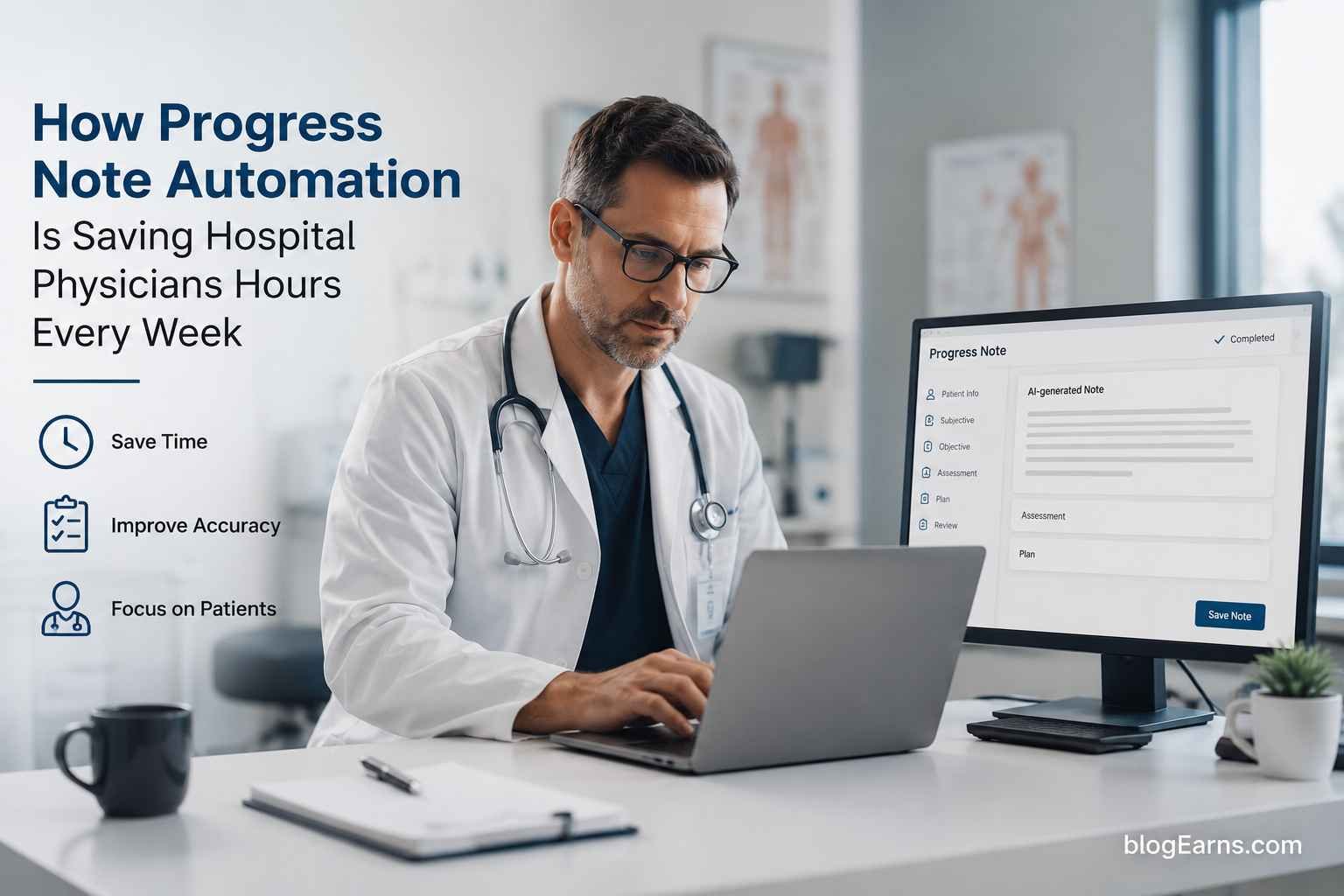
AI-assisted progress note generation works by using clinical data from the EHR — vital signs, lab results, medication changes, nursing notes, prior documentation — to pre-populate the structured elements of a progress note. The physician reviews, edits, and approves the generated note rather than writing it from scratch.
The time savings come from the shift between composing and reviewing. Composing a note requires active mental effort — retrieving clinical information, organizing it, and translating it into documentation language. Reviewing a pre-populated note requires a different, lower-effort cognitive process: verifying accuracy and making targeted edits where the generated content does not match the clinical reality.
Research published in JAMA Internal Medicine on physician time allocation in hospital medicine documents where documentation time goes and provides important context for understanding why progress note automation delivers such significant time savings in this particular specialty.
What Practices Can Realistically Expect
The time savings from progress note generation vary by physician documentation style, specialty, and patient complexity mix. Physicians who write detailed, complex notes from scratch see larger time savings than those who rely heavily on copy-forward documentation. The quality improvement dimension is also real — generated notes based on actual clinical data tend to be more complete and accurate than notes written from memory at the end of a shift.
For practices considering implementation, the evaluation should include a measurement period using actual time-to-note metrics rather than self-reported estimates, which tend to underestimate the time physicians spend on documentation because that time is distributed across the day rather than concentrated in a single block.
The combination of time savings and quality improvement — faster notes that are also better notes — is the outcome that well-implemented progress note automation delivers. Practices that achieve this outcome report significant improvements in both physician satisfaction and billing performance that sustain over time as the AI continues to learn from the practice’s clinical patterns.
Progress note automation is one of the clearest examples of technology that creates value on both the physician experience and the revenue cycle dimensions simultaneously. Faster notes that are also better notes — more complete, more accurate, and more closely tied to real-time clinical data — improve physician quality of life and billing performance at the same time.
Progress note automation is one of the clearest examples of technology that creates value on both the physician experience and the revenue cycle dimensions simultaneously. Faster notes that are also better notes — more complete, more accurate, and more closely tied to real-time clinical data — improve physician quality of life and billing performance at the same time, which is a combination that is difficult to achieve through any other operational intervention.